

OpenAI announced its own Muse/Instinct competitor Dots, new models, team environments, and lots more at Dev Day last week.
The announcement that’s flown relatively under the radar is its B2B marketplace.
OpenAI Marketplace launched at DevDay on 29 Sep 2026 with 32 partners. Eligible enterprise customers can put part of an existing OpenAI commitment toward those products.
The full set is:
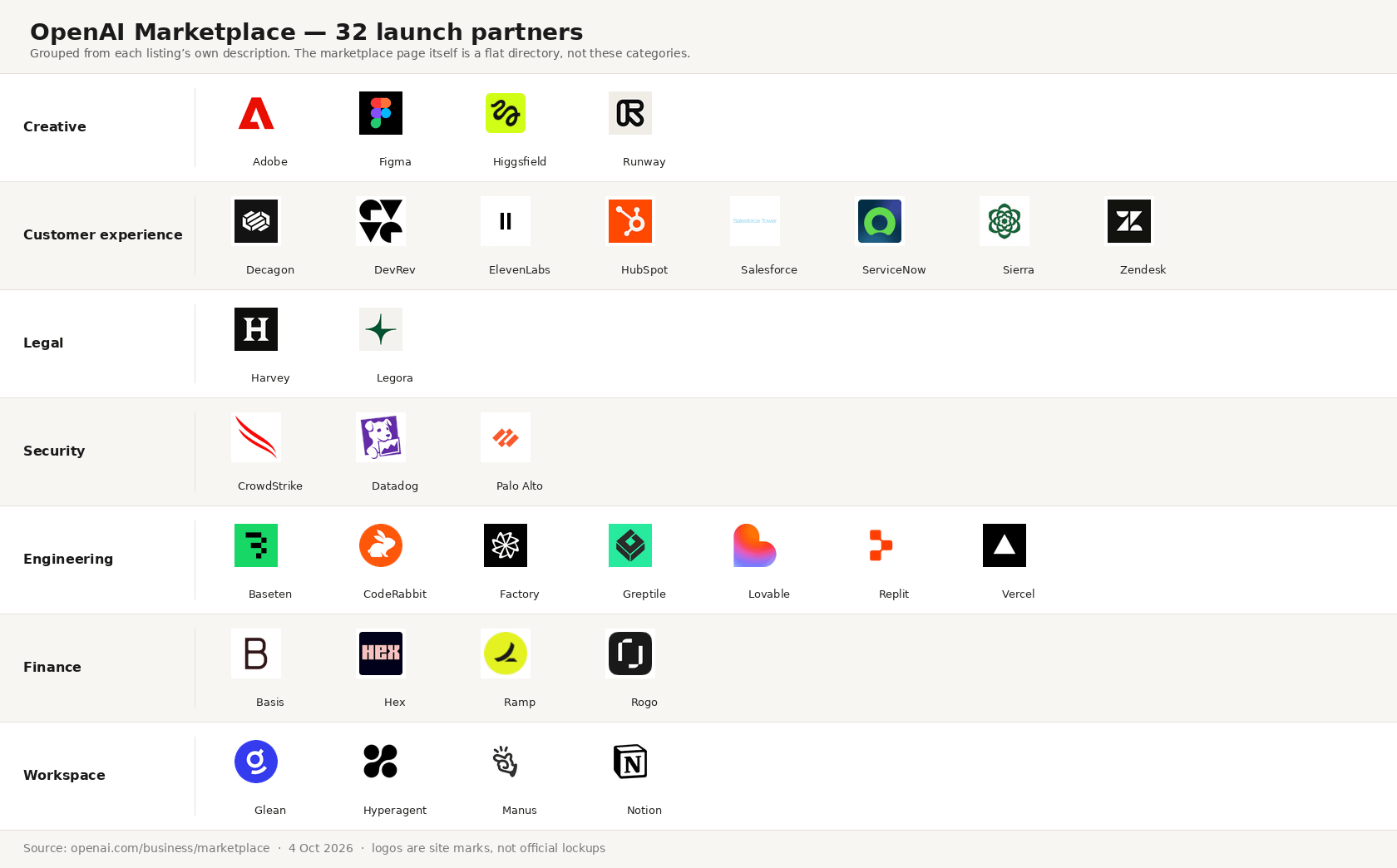
The most notable partner on this list is Baseten, given what it implies.
From the announcement:
OpenAI enterprise customers can now use existing OpenAI commitments for open models served by Baseten within Codex or via the Responses API. For enterprises, this means delivering even more intelligence per dollar through your existing OpenAI commitment.
Agentic coding is currently the most widely-adopted AI use case, and OpenAI’s Codex and GPT models are two of the most popular choices for scaling code generation workflows. With open models powered by Baseten now available to OpenAI customers, organizations can optimize agentic workflows across open and closed models and route each task to the best-fit model.
A lot has been said about open models eclipsing closed models on token volumes over the summer and the role this has played in a delay in Anthropic’s IPO.
If we use Vercel’s gateway as a proxy:
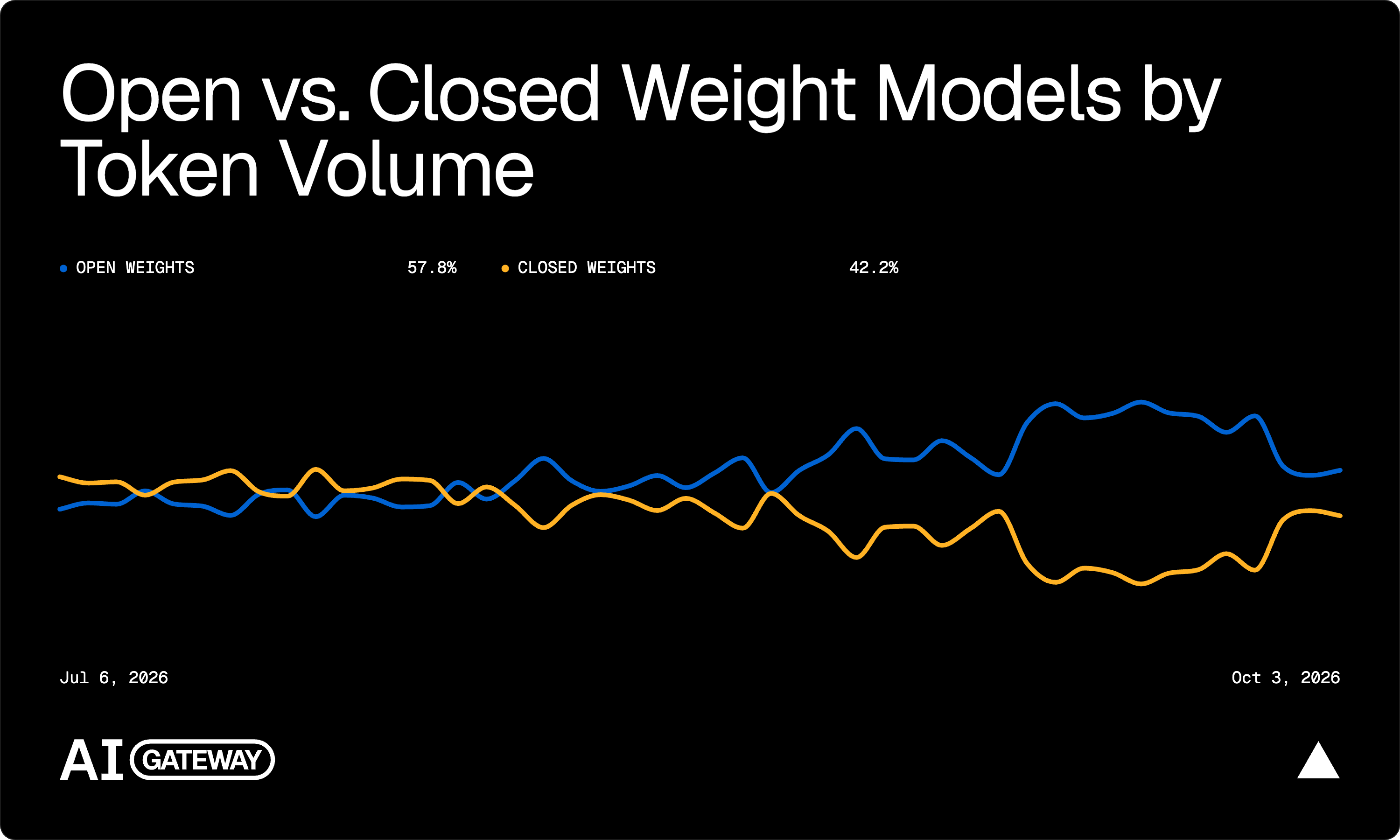
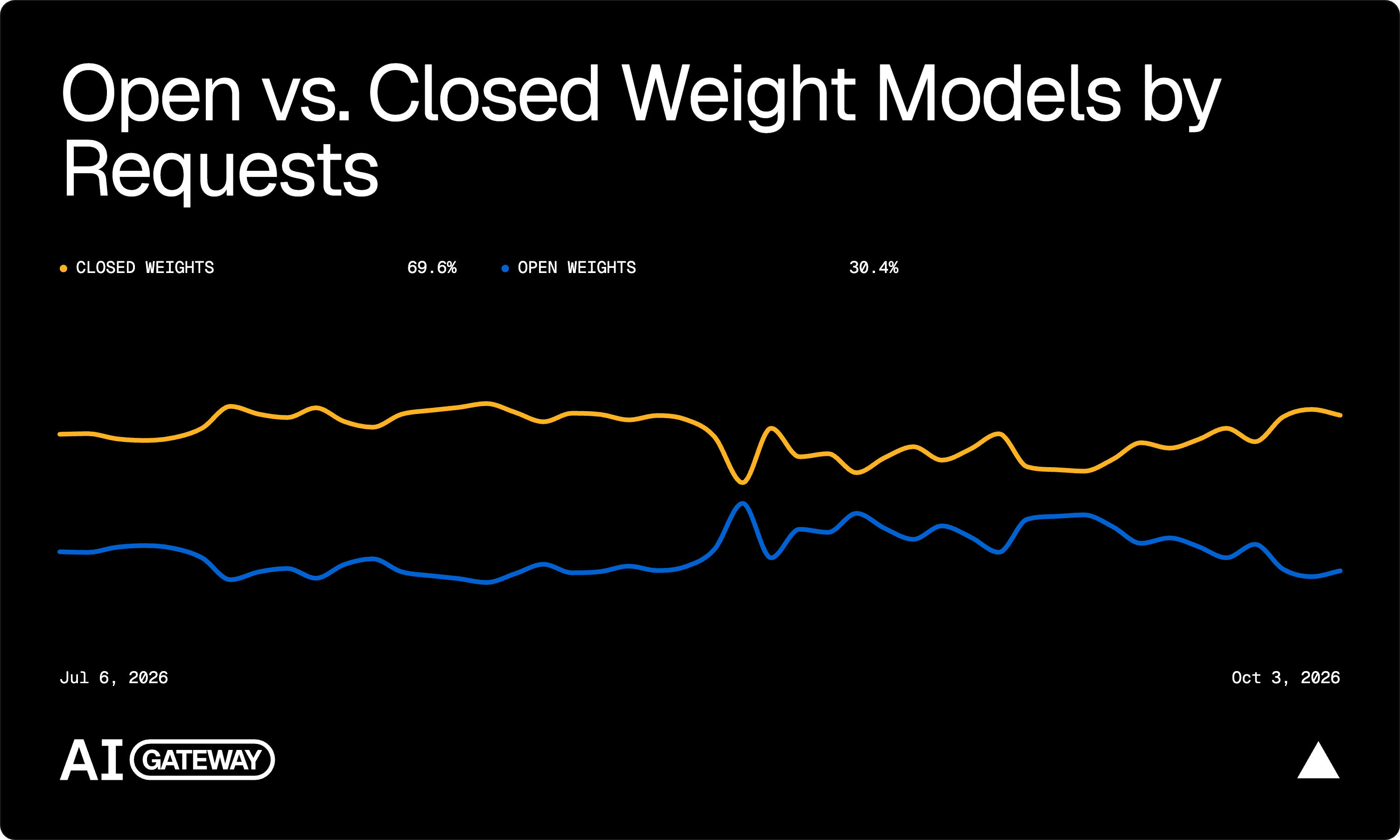
The first nuance that’s widely acknowledged is that although open weight token volumes have surpassed closed, spend and requests remain higher for closed models and the delta in token volumes is attributable to the higher token consumption of open models for the same tasks.
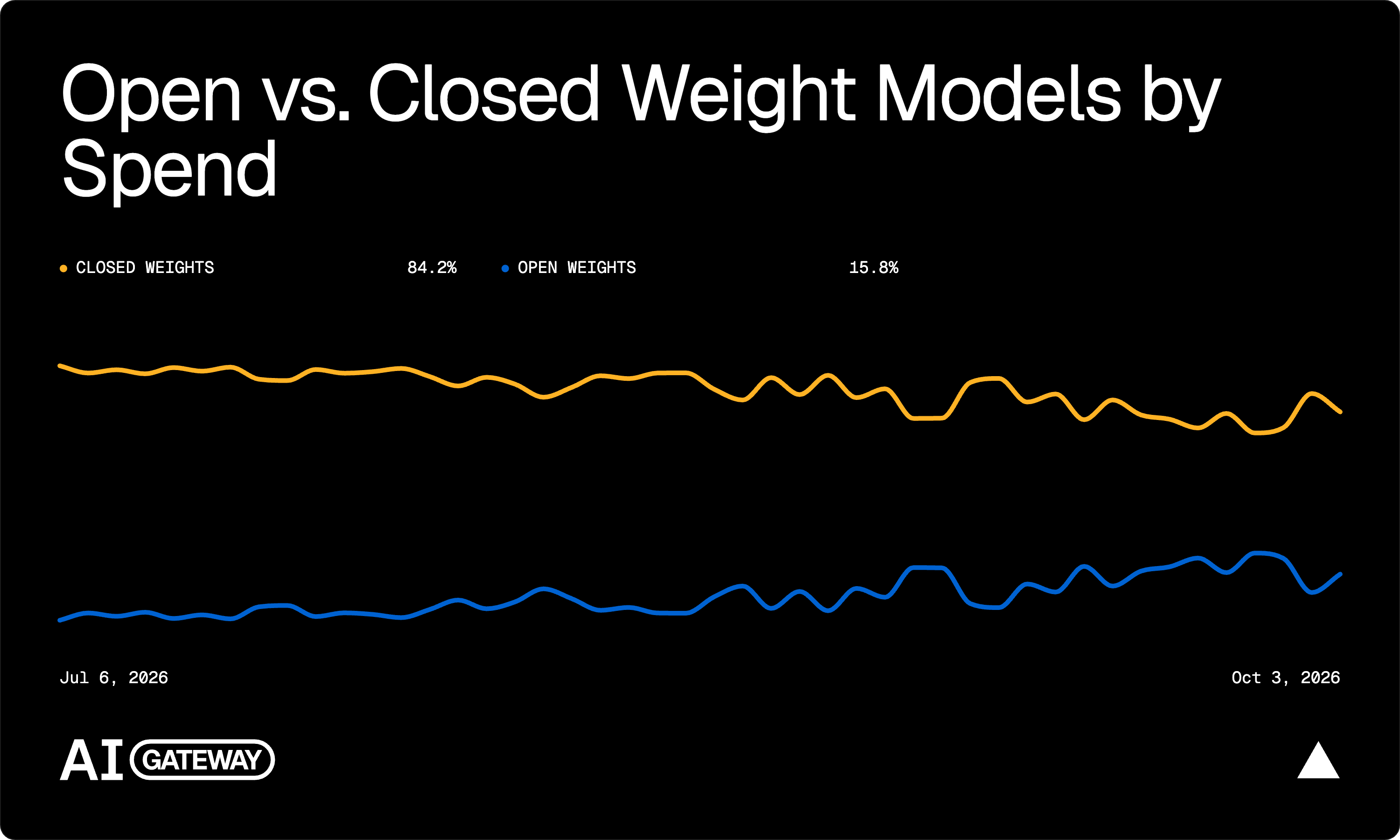
Ramp’s AI Index underlined this further - 5% of business spend going to open weight models.
This is a function of many reasons, but a clear recent development is how aggressively OpenAI and Anthropic are price-cutting to retain market share.
The Marketplace is another move consistent with this strategy, but the ambition is bigger.
OpenAI wants to position itself as the platform that the wider AI ecosystem is built on and relies on for distribution, just like hyperscalers became the distribution platform for enterprise software in the SaaS era.
Here are the similarities between OpenAI’s marketplace and the cloud ecosystem:
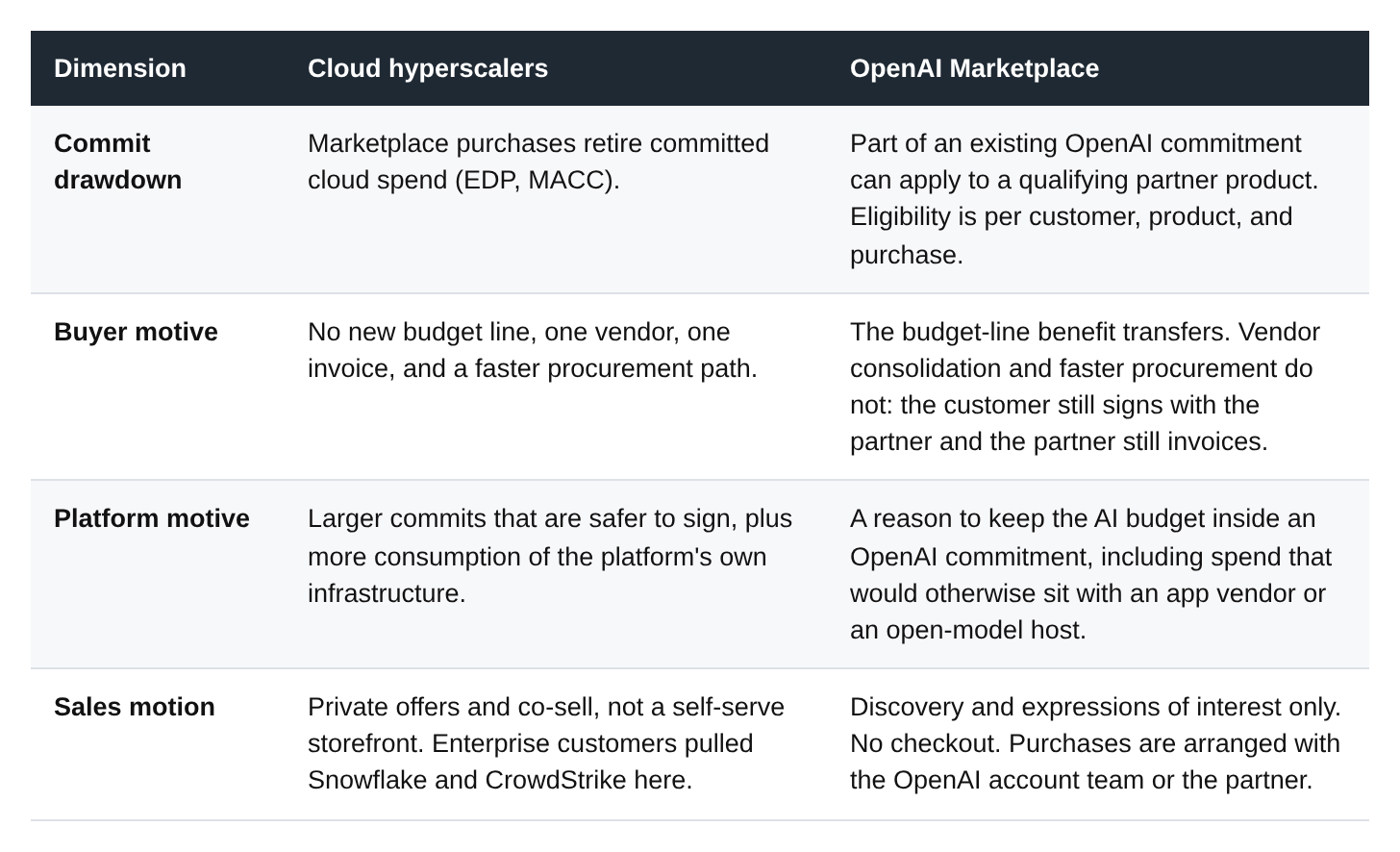
The intended benefits for OpenAI and its customers are clear to see: consolidation of AI sprawl and easier budgeting.
Given the nascency of the OpenAI marketplace relative to the cloud ecosystem, there are still lots of wrinkles to be ironed out to make the purchasing experience as seamless as it was for CFOs procuring enterprise software through cloud marketplaces in the 2010s. To hammer this point home, there are venture-backed startups entirely focused on helping with cloud marketplace GTM.
That same company, Suger, quantified the size of this prize: enterprise buyers sit on roughly $348B in committed cloud budget, and 62% of companies in Partner Insight’s 2025 report said cloud marketplaces are their largest source of net-new revenue.
OpenAI is said to be at c. $70bn run-rate revenue, of which enterprise is more than half. Most of the Fortune 500 are customers of either OpenAI and Anthropic, heralding the level of distribution that previously only the hyperscalers enjoyed.
They’re obviously not slowing down hiring either as they ramp up for their IPOs.
Ergo, the ISVs of this era, AI applications, are likely to complement their own GTM teams with those of the labs.
That brings us to the main differences, and there are many.
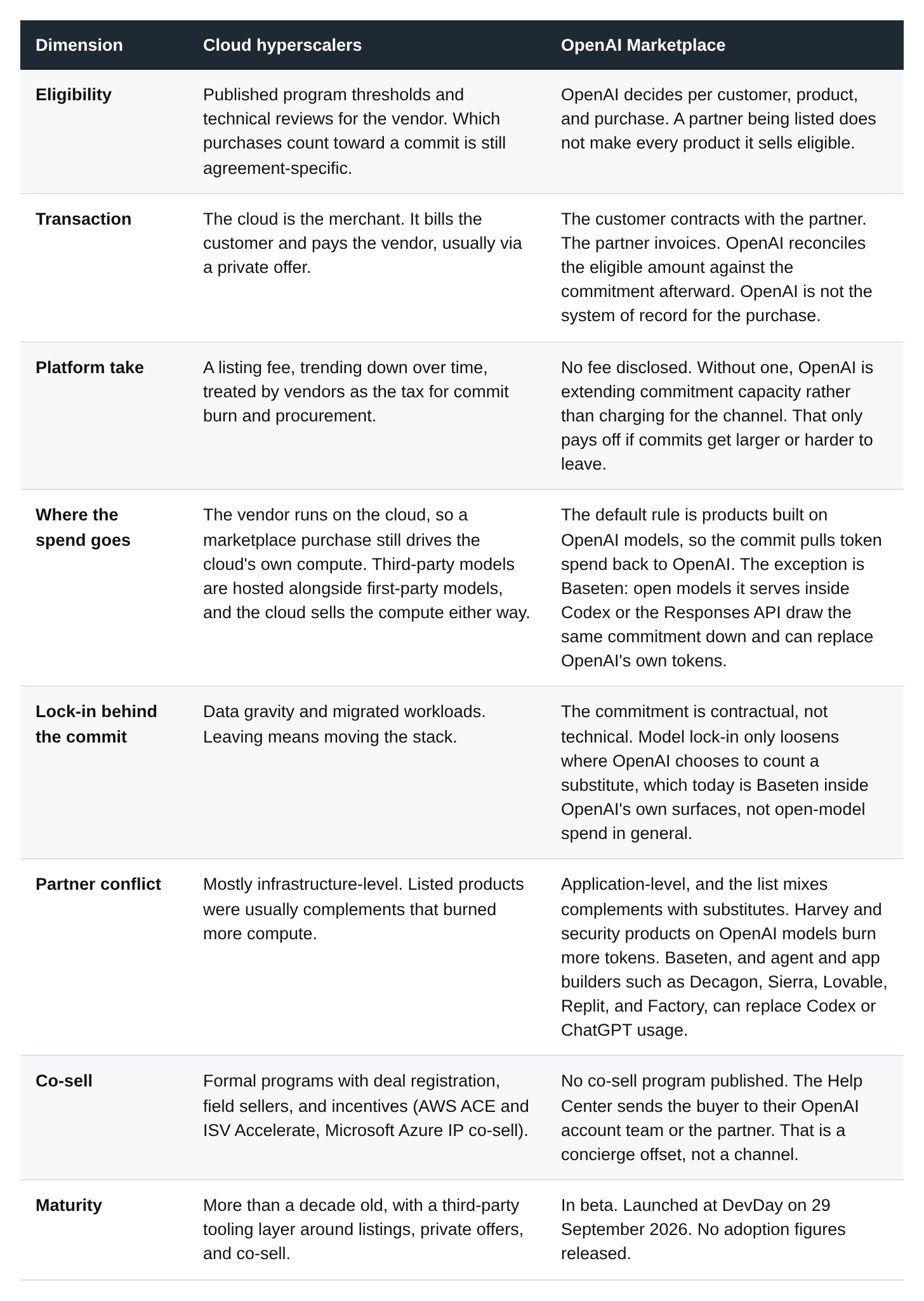
For now, customers invoice each vendor separately and OpenAI reconciles it. There’s no listing fee and no co-sell motion, as far as we know at the moment.
The starting assumption is eligible vendors will be those building on OpenAI models, but not exclusively. OpenAI spend allocated towards open-weight models accessed via Baseten are not driving underlying consumption of any OpenAI product - by contrast, in the case of the hyperscalers, all spend eventually trickled down to their compute/cloud offerings.
In sum, OpenAI has accepted it doesn’t need to be in the flow of tokens at all times; customer retention is more important.
If the marketplace starts to get traction, could we see an evolution similar to the cloud ecosystem where the labs and AI apps co-sell, apps get charged a listing fee, and buyers receive one invoice for their spend?
This is all predicated on the labs having sufficient enterprise distribution to justify these taxes, as well as the sustainability of the model when the labs won’t accrue value for big chunks of spend (open-weight inference).
This isn’t the first time OpenAI has tried to build an ecosystem on its distribution. GPT store, apps SDK, and plugins were all past attempts at owning distribution inside ChatGPT.
This time, partners are pulled onto OpenAI’s commercial relationship and APIs, rather than onto the ChatGPT interface.
Anthropic is less likely to follow OpenAI’s efforts, given its more explicit efforts to compete with its customers. This gives OpenAI a free run at building an ecosystem on its distribution.
The most bullish case is one where OpenAI acquires such market power to enforce more usage of its models for listing eligibility, thereby becoming more like the hyperscalers who enjoyed a win-win scenario no matter how customers allocated their cloud spend. If OpenAI follows through on Sam Altman’s wishes, open-weight consumption by AI app companies would also reduce:
Our goal is to offer, at every point along the Pareto optimal frontier, the best option for intelligence and price. And that includes open source.
The bearish take is one where the purchasing experience is not streamlined and therefore the benefits to procuring AI apps through OpenAI contracted commitments is negligible. Moreover, there could be a power-law where of the 32 partners, most of the reallocated spend is towards Baseten’s open-weight model catalogue, where OpenAI definitely isn’t in the token flow. OpenAI retains the customer relationship but fares worse economically.
We won’t have to wait long to see how this goes, as there will definitely some form of a report card on this bet by the time the OpenAI S-1 drops in H1 ‘27.