

Upcoming Events in London
May 20th: Pydantic x Glyphic Engineering Night
May 28th: Inference Stack Innovation with Crusoe
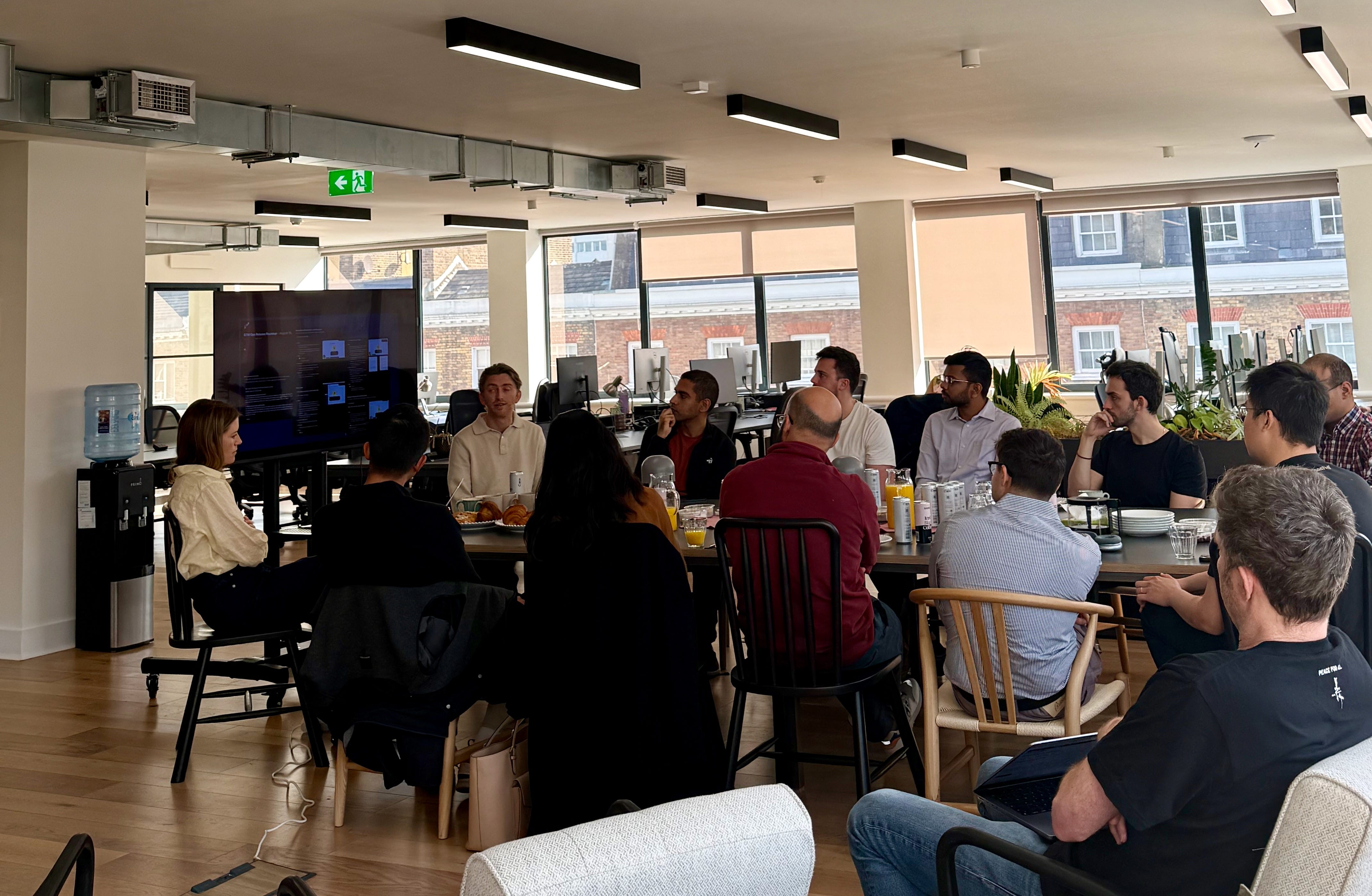
We recently hosted Ellen Moeller McCormack and Archie Moore from Clay’s London office for a discussion on GTM engineering. We covered a ton of ground and I’m excited to share the notes with you!
GTM is converging on engineering as a discipline, not a metaphor
The opening argument from Archie set the frame for the rest of the conversation. Product organisations have largely figured out how to ship quickly. Claude Code and similar tools have collapsed the cycle time for shipping features, but go-to-market has not kept pace. Most GTM stacks remain spaghetti: a sales engagement tool here, an enablement platform there, a CRM stitched in with brittle integrations.
The teams getting an edge are the ones treating GTM the way engineering treats product: sprint-based, iterative, with a roadmap of “plays” rather than a static playbook. Clay runs an internal Kanban board for GTM ideas, sourced from anyone in the business (co-founders to SDRs), with sprint cycles ranging from two days to several months depending on the play’s life cycle.
The role enabling this is the GTM engineer, closer in DNA to rev ops than to a seller but with a tighter pulse on what’s happening at the revenue front line. Ellen noted it’s currently among the fastest-growing roles being hired under the GTM umbrella. The point Archie made repeatedly: you don’t need to be a GTM engineer to do GTM engineering, but you do need to create the organisational space for it.
Every play has a half-life, and “GTM alpha” is the portfolio response
Borrowed from finance, GTM alpha is the framing Clay uses to describe permanent edge in the market. The claim is that any individual play degrades over time, whether competitors copy it, the market gets noisier, or the play’s underlying signal goes stale. Two examples Ellen offered:
HubSpot’s inbound content marketing was a multi-year alpha generator, but the effectiveness curve has been declining for the last two years. Their response has been to start running outbound (something they’d never done before) using Clay.
Cold outbound email, which worked at volume a decade ago with generic copy, is now near-dead in its undifferentiated form. The replacement isn’t to abandon outbound but to compose it differently: right person, right content, right time, with the time component increasingly driven by external signals.
The implication for founders is uncomfortable but useful. A successful play is not a permanent asset; it’s a depreciating one. The portfolio question (how many plays should be running simultaneously) got a practical answer from Archie. Clay runs roughly one new play per week , with some plays kept evergreen in the background (job changes was the example) and others run as time-limited sprints. For matrixed product lines, that count multiplies across business units.
The upstream constraint is unique data, not channel mechanics
One of the more analytically useful sections concerned what makes a play actually distinctive. Generic third-party data (firmographics, technographics from standard providers) produces generic outreach. The differentiated plays come from layering unique data sources:
Internal data: closed-lost accounts, previously DQ’d opportunities, contacts who’ve changed jobs to new companies that might now be in-ICP.
Composite third-party signals: A customer support platform found that fertility clinics over-indexed on their ICP combination of “large FAQ + high support ticket volume.” Another example was of a design platform where its best SDRs were scouring LinkedIn for posts that broke brand guidelines, screenshotting them to CMOs.
Custom-built data points: A waste management provider used Google Maps imagery to detect dumpster colour outside commercial buildings (green = theirs, blue = competitor). A healthcare seller stopped using employee count as a hospital-size proxy and started scraping bed counts from hospital websites because research hospitals distorted the headline metric.
The pattern across these is that the data point itself encodes a piece of domain insight that competitors haven’t yet operationalised. The half-life can be short (these are not durable moats) but the cumulative effect of running a portfolio of these is what produces alpha.
Maturity is a three-stage curve from individual hacks to deployed infrastructure
Clay’s framing of how organisations grow into GTM engineering followed a three-level structure:
Level 1: individual pockets. Individuals across the company are already doing creative things, often with tools they pay for themselves. One attendee described building custom one-pagers in 15 minutes plus a sub-45-second Loom, and breaking into five enterprise accounts in ten days under outbound pressure from their manager. Another described sending physical co-branded SIM cards to fintech prospects. The prospect installs it, sees the seller’s brand on their phone, and the seller has a tangible artefact in front of the buyer.
The actionable point Ellen made for founders: most teams run product brainstorms but almost never run GTM brainstorms. The first move at Level 1 is harvesting, going to the best individual performers and asking what’s actually working, then asking the second-order question: what is it about this that’s working, and can we systematise it?
Level 2: standardisation. Once a play works at the individual level, the question becomes which parts can be lifted into infrastructure that runs across the team. The examples discussed:
CRM hygiene: at high-velocity rep counts (30 to 40 meetings/week), manual CRM updates are a losing battle. Clay’s approach is to auto-populate fields from call transcripts but keep humans in the loop for stage progression, and route denials back to the agent builders with explanations, creating a feedback loop.
Inbound speed: shortening form fields and using de-anonymisation plus routing logic to hit inbound leads within minutes rather than hours. The conversion drop-off in the first hour is steep enough that there’s no excuse for the latency anymore.
Closed-lost analysis: most teams do this manually at end-of-quarter, by which point insights are stale. Automating transcript analysis on every lost deal, piping product gaps into engineering’s roadmap intake, and then closing the loop by re-engaging lost opportunities when the gap gets shipped.
Competitive mention extraction: mining calls for competitor mentions and product gaps, then feeding the knowledge base that downstream agents draw on. The knowledge base improves automatically as more calls accumulate.
Level 3: GTM alpha. This is where the culture of shipping plays is ingrained and the infrastructure is mature enough to deploy them broadly. Notably, even at this level Clay does not run fully autonomous AI SDRs on outbound; humans still check outgoing emails. The genuinely automated workflows tend to be inward-facing: closed-lost analysis, QBR generation, knowledge base maintenance.
Two operational tensions that scale worse than founders expect
Two threads in the discussion are worth pulling out separately because they’re under-discussed and likely to matter more as teams scale.
Versioning and propagation of skills and agents. One attendee asked how a non-engineering team should handle skill versioning. When five people build their own variant of “call analysis,” whose version becomes canonical? Archie’s answer was honest: both happen, ideally sequentially. Encourage individual experimentation early because it preserves creativity, but move proven agents into a centralised library where updates propagate to every workflow that calls them. Notion as a shared knowledge base, plus a designated owner (a GTM engineer or ops lead) whose job is precisely to harvest and centralise, is how Clay handles it.
Org readiness outranks tooling as the binding constraint. This came up most sharply from an attendee at a fast-growing fintech with senior, high-performing reps who refuse to update CRM and use Granola instead of the company-standard call tool. The reps hit quota, the company is winning, and so the lever to enforce process discipline is weak. The room’s collective answer was that the time to invest in operational maturity is before growth decelerates. Public-market analogues are instructive here: waiting until growth slows means the market punishes you before you can course-correct. Pre-IPO investors increasingly discern between AI-native and non-AI-native operations, and GTM rigour is one of the measures.
Seven takeaways for founders
Run GTM brainstorms with the same cadence as product brainstorms. Your engineer may have your next outbound play. The cultural permission to experiment has to come from the founder.
Treat plays as a portfolio with deliberate cadence. Roughly one new play per week per person doing outbound, with a small number of evergreen plays running in the background. More than that and the cognitive load destroys signal.
Score leads on attributes, not on play attribution. Lead scoring at the account level (size, funding, location, fundamentals of fit) is the baseline infrastructure that lets you detect when a play is degrading. If scores drop from 8 to 10 down to 3 to 5, the play is telling you something.
Invest in the boring infrastructure early. CRM hygiene, transcript pipelines, knowledge base maintenance. None of these are alpha-generating in themselves, but they are the substrate on which alpha-generating plays run. Skip them and your creative plays sit on broken data.
Hire, or designate, someone whose job is harvesting and systematising. Without this role, individual creativity stays trapped at Level 1. The role doesn’t need to be called “GTM engineer,” but the function needs an owner.
Buying committees are shifting fast. ICP analyses run 18 months ago are likely already stale. The committee composition for tech purchases has been shifting toward broader executive involvement, and any “definitive” buyer map is a snapshot, not a fixed asset.
Be honest about where humans still belong in the loop. Closed-lost analysis and QBR generation are good candidates for high automation. Outbound emails to named accounts are not, yet. The distinction is whether the failure mode is recoverable.
The framing that probably matters most: in a world where product alpha is compressed by AI-driven shipping velocity, GTM alpha is where durable execution edge increasingly lives. For founders, the consequence is that GTM rigour is no longer a Series B problem to defer. It’s a discipline to build into the company culturally from day one.
Wedge is Clay's Startup GTM Accelerator. The two-week async program helps the top early-stage GTM leaders learn Clay as their GTME infrastructure, build workflows directly with our team, and earn thousands of credits as they progress and graduate. Learn more and apply here. Explore Clay's full Startup Program here.
The idea of GTM working more like product engineering makes a lot more sense now