

I came away from GTC Berlin with lots of notes on Nvidia’s product portfolio and the neocloud market.
Let’s get into it.
Jensen Huang’s keynote
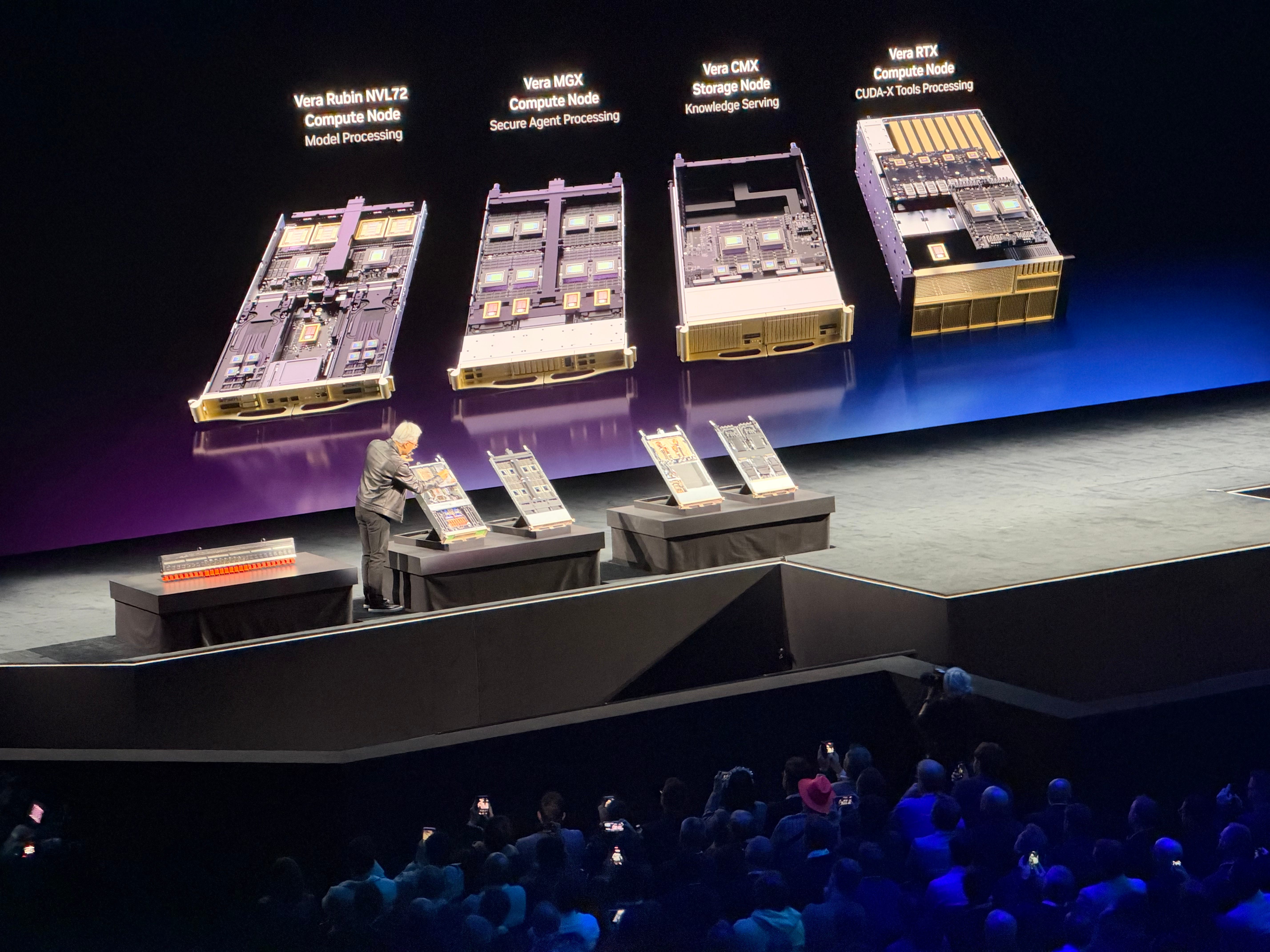
Nvidia in Europe
Nvidia’s relationship with Europe goes way back.
Some history:
NV1 was manufactured with SGS-Thomson in Crolles and assembled in Malta.
MediaMarkt was the largest early GeForce customer.
Of late, Nvidia has invested nearly $10B in Europe over the past year, with European customers including L’Oréal, Revolut, Spotify, Merck, Vodafone, Zara, Porsche, Nestlé and HSBC.
Generational Improvement
Tracing the last 10 years of Nvidia GPUs from Pascal, Volta, Ampere, Hopper, Grace Blackwell and now Vera Rubins, Jensen Huang said the improvement has been 1,000,000x, versus the ~100x that would have been predicted from Moore’s law.
Blackwell was ~30x Hopper on LLM processing.
Vera Rubin is another ~30x on top of Blackwell, “in just two years.”
DSX and DSX POD
A 1 GW AI factory costs ~$50B (land, power, shell, compute, networking, cooling).
It generates ~$40B a year of revenue.
A three-month delay therefore forgoes ~$10B.
DGX-1 (2016) was one node. NVL72 moved rack assembly into the supply chain. “Every computer manufacturer in the world now manufactures NVL72.”
The new DSX Pod drops deployment from ~6 months to as little as 14 days at a prepared site. It’s seven Vera Rubin NVL72 racks plus 17 km of Spectrum-X cabling.
Integrated, burned in and tested in the factory, then shipped in transportable containers.
Partners include Anduril, Armada, Bull, Crusoe, DayOne, Dell, and many more.
Agent security: OpenShell and Sentry
OpenShell:
Open source under Apache 2.0, first announced at GTC San Jose in March.
Each agent runs in its own sandbox with no direct network route.
Policy is enforced at the level of syscalls, file access and network connections.
Every outbound request goes through a supervisor outside the sandbox. Keys stay with the supervisor and are added only on the way to an approved endpoint.
Sentry:
An optional hardware layer on BlueField-4, in a trust domain separate from the host.
Agent reasoning traffic passes through it, so it can quarantine an agent in milliseconds.
Models
Nvidia’s open model families:
Nemotron (language)
Cosmos (world models)
GR00T (humanoids)
Alpamayo (AVs)
Ising (quantum-classical)
Earth-2 (physics AI)
BioNeMo (biology)
Unstructured data: Nemotron Parse, then Nemotron Embed, then cuVS vector search, then Nemotron Rerank.
Structured data: Auto-Ontology, then analytical (cuDF) or predictive (Kumo).
In Tabular Data, a “BeyondArena” leaderboard showed Kumo-Tabular first and TabPFN-3.5 (from Prior Labs) second.
Post-Training Ecosystem
Nvidia releases weights, training data and scripts, so provenance can be verified and the model reproduced.
Customization examples:
@AI21Labs (with a customer) - @baseten with @coderabbitai - @trajectorylabs with @harvey - @scale_AI with Skydance - @PalantirTech with Tampa General Hospital
The ecosystem of post-training partners includes Mercor, Handshake, AfterQuery, Scale, Thinking Machines, Applied Compute, Prime Intellect, Baseten, Fireworks, LangChain, Letta, Cohere and Mistral.
CPUs
Agents turn the CPU back into a latency bottleneck, and Nvidia’s answer with Vera is per-core speed under load rather than core count.
My working hypothesis going in was that scaling CPUs for long-horizon agents is mainly a core-count problem.
An agent loop is sequential: call a tool, process the result, hand it back to the GPU. A single loop cannot be spread across more cores, and the GPU sits idle while it runs.
So agentic CPUs need two things at once: enough cores for concurrency, and fast enough cores to shorten each loop. Nvidia’s Ian Buck (inventor of CUDA) has framed the point as “how fast a CPU can answer one question”. CPUs can account for up to 90.6% of an agent’s total latency.
Design choices for Nvidia Vera CPU
Fewer, faster cores. Vera has 88 custom Arm-based Olympus cores with 176 threads via spatial multithreading, compared to 288 cores on Intel’s Clearwater Forest, 256 cores and 512 threads on AMD’s EPYC Venice, and 136 on Arm’s AGI CPU. While its core count is lower, it offers high bandwidth interconnects for memory sharing with Nvidia GPUs.
One monolithic die. All 88 cores sit on a single die, unlike the chiplet designs of Nvidia’s x86 competitors. The argument is core-to-core latency: crossing chiplets through an I/O die adds delay whenever cores share context. Chiplets exist for yield and cost, which suited a decade of selling cheap cores through VMs; Nvidia had no chiplet legacy to unwind.
Bandwidth over capacity. Memory is LPDDR5X on SOCAMM modules: up to 1.5TB at 1.2TB/s, sustaining over 90% of peak under load, at less than half the memory power of traditional DDR.
x86 parts boost individual cores using headroom from idle ones, so per-core speed falls as the socket fills; Vera is designed to hold per-core performance with all 88 cores busy. For sandbox providers, that means higher packing density without a latency penalty.
Memory remains a bottleneck, with no clear solution for HBM stacking reaching its limits.
LPUs
Groq LPX rack of LPUs
Each rack holds 256 Groq 3 LPUs in 32 liquid-cooled 1U trays, eight LPUs per tray, built on Nvidia’s MGX rack architecture alongside the Vera Rubin platform.
It draws up to 160kW, the same as a Vera Rubin NVL72, so it fits into data centers already built for Vera Rubin.
Each LPU carries 500MB of on-chip SRAM at 150TB/s. Across the rack that is 128GB of SRAM, 40PB/s of SRAM bandwidth and 640TB/s of scale-up bandwidth.
128GB is far too little to hold trillion-parameter models. The rack’s job is to accelerate decode (token generation) next to an NVL72, not to serve whole models on its own.
Networking
Spectrum-X and the “all optical” nuance
The LPX rack links to a neighbouring Vera Rubin NVL72 over a custom Spectrum-X interconnect.
Connections inside the rack run over a copper backplane. Optics are used only between racks, through front-panel ports. The design packs compute densely enough that copper covers all in-rack links, so optical transceivers aren’t needed there.
Spectrum-X comes from Mellanox, which Nvidia bought in 2019 for about $6.9B. Nvidia is the top data center Ethernet switch vendor in the world.
On stage, Jensen called Spectrum-X the world’s first co-packaged optics switch. The silicon photonics attach directly to the switch chip through COUPE, a process Nvidia developed with TSMC. It supports 512 ports at 200Gb/s and is now in full volume production.
This delivers on the March 2025 GTC unveiling, when Nvidia claimed 3.5x energy savings and 4x fewer lasers than pluggable transceivers.
CPO will move into scale-up (where NVLink links between GPUs in a rack). NVLink 8 CPO is slated for 2028, and Kyber will scale to NVL1152 using direct optical links between racks. Nvidia will do both copper and optical scale-up.
Quantum
Nvidia’s position: everything around the QPU, not the QPU
Nvidia builds no quantum processors. It positions itself in a support role, with software, AI models and tools that run alongside other companies’ hardware.
The controller link: NVQLink
NVQLink is an open interconnect between quantum processors and AI supercomputers, designed to work with every qubit type: superconducting, trapped ion, neutral atom, photonic and others.
Each link runs at 400Gb/s over RDMA Ethernet with GPU-to-QPU latency under 4 microseconds. Fast error correction needs that deterministic, microsecond-scale response, which ordinary Ethernet can’t guarantee.
17 supercomputing centers across Asia, Europe and the Middle East plan to adopt it, on top of 9 US national labs. Quantinuum used it to run a real-time decoder for qLDPC codes, with an error-correction reaction time of 67 microseconds.
Programming and error correction: CUDA-Q
CUDA-Q launched in 2022 as a hybrid quantum-classical programming platform, the quantum counterpart to Nvidia’s CUDA libraries.
CUDA-Q QEC, the error correction library, covers code definition, syndrome decoders and real-time decoding on live hardware. Since GTC 2026 it plugs into a new real-time NVQLink library, so any hardware vendor on NVQLink can run GPU decoding inside its control loop.
Calibration: the Ising models
Nvidia released Ising in April 2026: a 35-billion-parameter vision-language model for calibration, plus decoding models for error correction. Nvidia says the calibration model cuts tuning time from days to hours, and the decoders are up to 2.5x faster and 3x more accurate than traditional approaches.
Atom Computing, IonQ, IQM and Q-CTRL are among those already using the calibration model. At GTC Berlin, Nvidia said IQM uses Ising to calibrate its processors, and SEEQC pairs it with NVQLink for low-latency error correction.
Neoclouds
A recurring meme on X is the inevitability of becoming a neocloud, given the backdrop of rising GPU prices. It was no surprise there was a dozen or so neoclouds with booths at GTC.
Some are public, most are still private.
CoreWeave’s debt recently reached yields of c. 16%, with spreads on credit default swaps reaching distressed levels. The nuance of course is that the cost of borrowing at the asset-level (GPU financing via SPVs) is much lower, but in general the market jitters are based on reasonable concerns around rising cost of capital across the board.
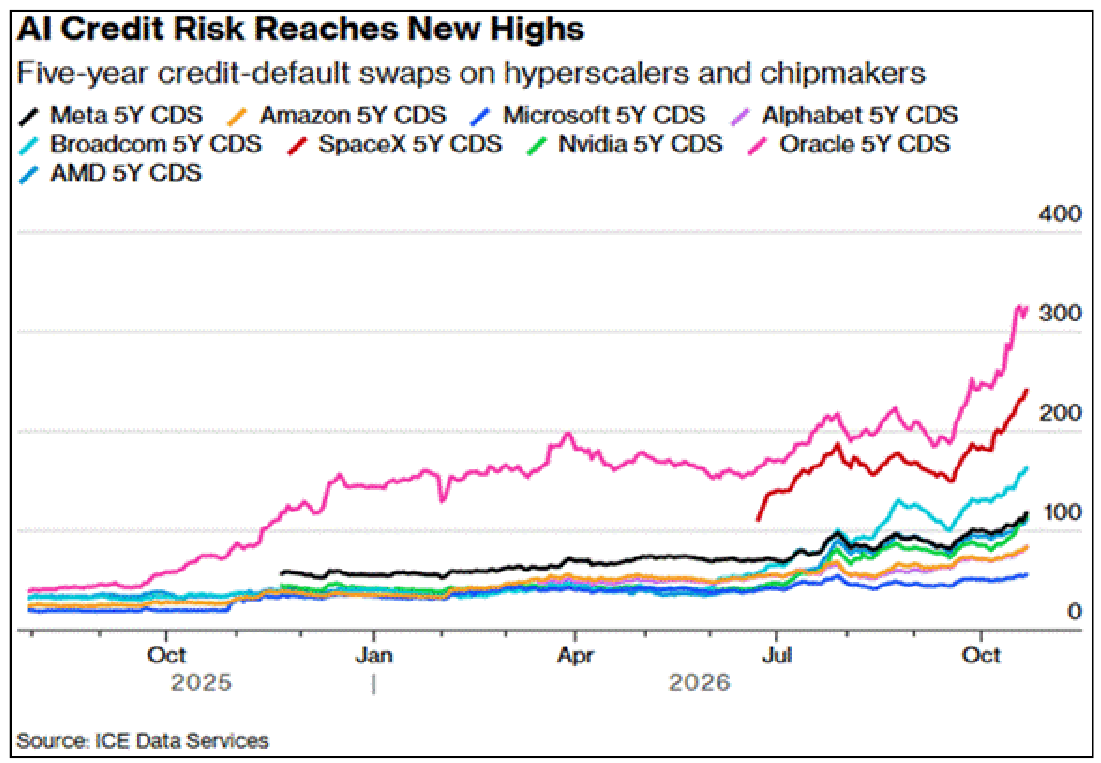
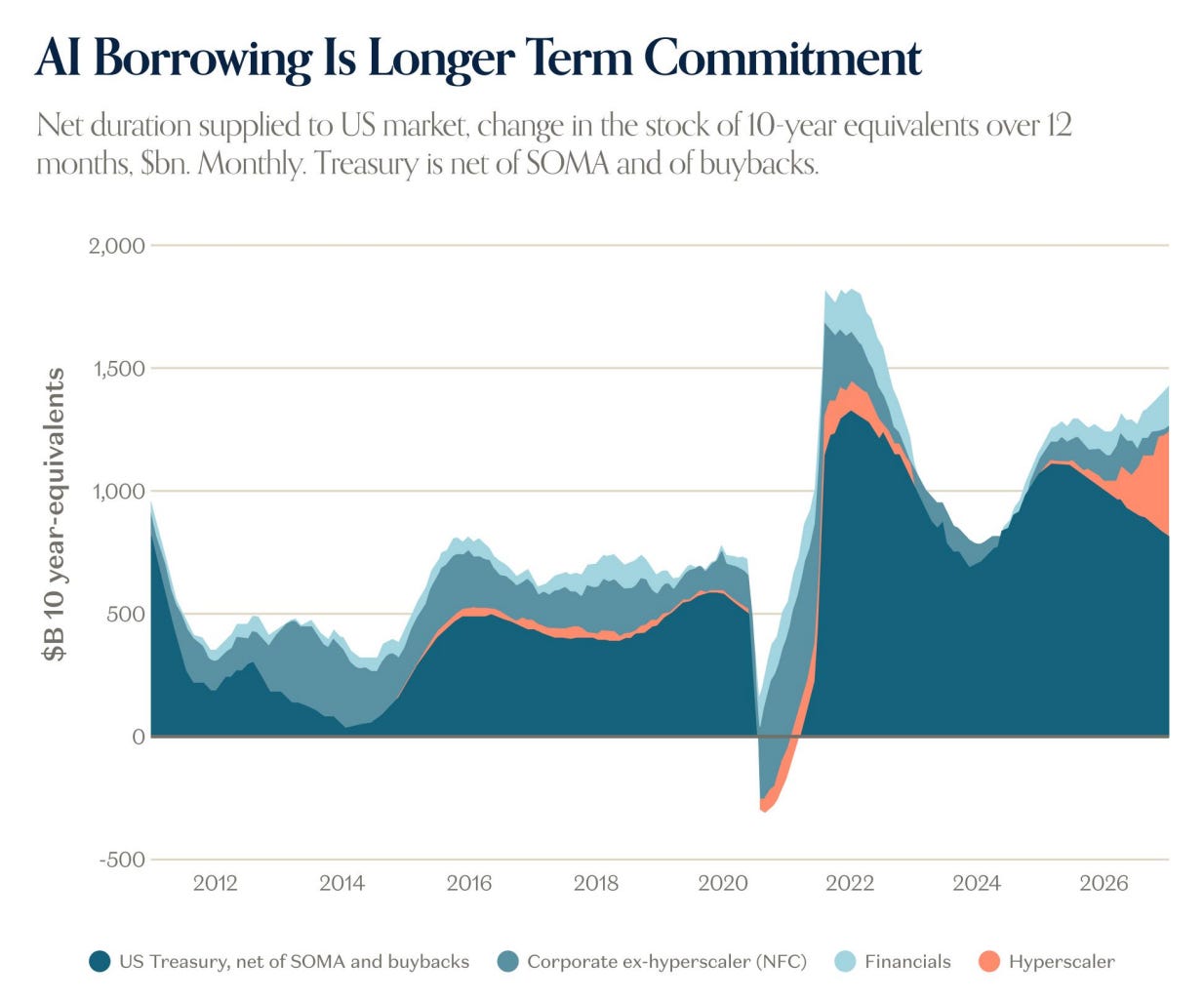
Howard Marks emphasised the structural nature of the higher yield environment we’re in now in his latest memo, and how unlikely it is to reverse anytime soon:
Looking ahead, the AI buildout is likely to cost trillions of dollars, with McKinsey & Company estimating that over $5 trillion will be spent worldwide through 2030 on data centers directly related to AI. A fair bit of this will probably be borrowed, but even that which comes from the sale of equity will draw from the total supply of available capital, affecting the interest rates bonds must pay to attract investors. At the same time, the Treasury will have to refinance an enormous volume of maturing securities while financing the annual deficits. Most of its issuance will merely roll maturing debt, but the new net issuance of roughly $2 trillion will add to the supply investors must absorb, putting upward pressure on yields and arguing against the likelihood of a decline in interest rates anytime soon.
All this preamble is to underline that financing strategy may arguably the most important variable in determining success for neoclouds.
Cost of capital
Radiant is a vehicle of Brookfield’s AI fund, which targets $10B of equity and up to $100B with co-investment and financing; Nvidia contributed to the fund’s initial capital. Before the merger, Ori had financed about $100M of GPU servers and networking through equipment leases.
Brookfield merged Radiant with Ori in February 2026 to create a vertically integrated neocloud, from land and power all the way to inference. Brookfield’s focus for Radiant is on the hyperscalers and enterprises rather than AI-natives.
Volta’s a new entrant into this market, raising a few rounds of equity funding in quick succession from a16z and Altimeter on its way to a $2.4bn valuation. Volta’s pitch is not to rely on backstops from Nvidia like other neoclouds, instead launching with a ‘$5 billion infrastructure program with Azora, a real estate and infrastructure asset manager, for project equity, alongside senior infrastructure debt led by international banks’.
JPMorgan and Goldman Sachs underwrote a $1.3bn term loan out of a $5bn debt package that Volta went out to raise for a Norway data centre, which Apollo anchored with a $1.5bn order. Anthropic is meant to be one of Volta’s biggest offtakers.
Initial estimates were for this debt to be priced at c. SOFR + 500, but more recent estimates landed at SOFR + 625 (c. 11%). As a result, relative to other neoclouds focused on hyperscalers as offtakers, Volta’s cost of capital is higher (Anthropic and OpenAI’s bankers are pushing for investment-grade credit ratings post their respective IPOs). Relative to Fluidstack, for example, where Broadcom and Google are backstopping the TPU fleet and repayments, the equivalent investment-grade backstop is missing. The FT recently reported that Anthropic was pitching Blackstone on another TPU financing deal at a cost of >10%, supporting the idea that lenders are pricing Anthropic’s credit risk around that ballpark.
Power
Access to power came up as one of the main vectors of differentiation.
Radiant has access to Brookfield’s land, power and data centers, including 1GW of behind-the-meter generation via Bloom Energy.

As an aside, Bloom is a good example of how AI demand will drive down cost curves for a number of upstream technologies:
Bloom can now run its factories full, expand them, drive unit costs down the curve, and reach the point where fuel cells compete in mainstream power markets with no subsidy at all. Further, the same solid-oxide platform, the same tooling, the same engineers also produce Bloom’s electrolyzers – the equipment that turns electrons into green hydrogen for steel, ammonia, shipping, and high-temperature industrial heat.
Since the cost of green hydrogen is mostly the cost of the power and the machine that makes it, these hard-to-abate markets have been waiting on two things: cheap electrons and cheap electrolyzers. AI demand is now paying down both. A decade of climate policy couldn’t fund that learning curve; eighteen months of hyperscaler capex might.
Volta leases Bitdeer’s hydro-powered Tydal campus, with Phase I due by the end of December 2026 and Phase II by the end of March 2027; its pipeline exceeds 1GW across North America and Europe.
Verda focuses on renewable, naturally cooled sites in Finland and Iceland, a hub under construction in Sundsvall, Sweden, and UK capacity through colocation and third-party partners.
Nscale relies on Norwegian hydropower, whilst Microsoft walked away from a Loughton campus that isn’t supposed to get power until the 2030s. It also relies on behind-the-meter gas in West Virgina.
IREN has grid connections from its bitcoin mining origins.
Crusoe’s Abilene site for Oracle and OpenAI runs on the grid with gas for backup only; its 900MW Microsoft campus will run on on-site gas turbines.
Behind-the-meter trades grid connection risk for permitting and execution risk.
Nvidia Reference Design
Nvidia’s DSX reference design is becoming the industry standard.
Most of the neoclouds build to this standard, consistent with Nvidia’s efforts to create a synthetic hyperscaler to unlock more institutional capital.
Moving Up The Stack
All of the neoclouds are moving beyond bare metal and offering inference software:
Radiant and Ori merged
Volta acquired Genesis
IREN acquired Mirantis
Nscale acquired Anyscale
Nebius acquired Tavily, Eigen AI
Crusoe acquired Atero