

Data from Ramp revealing the degree of revenue concentration at the labs was a Rorschach test.
The bullish take is that the top 1% are simply early adopters and the rest would reach similar spending levels, whilst others saw that same 1% plausibly switching to open models at the expense of the labs’ margins.
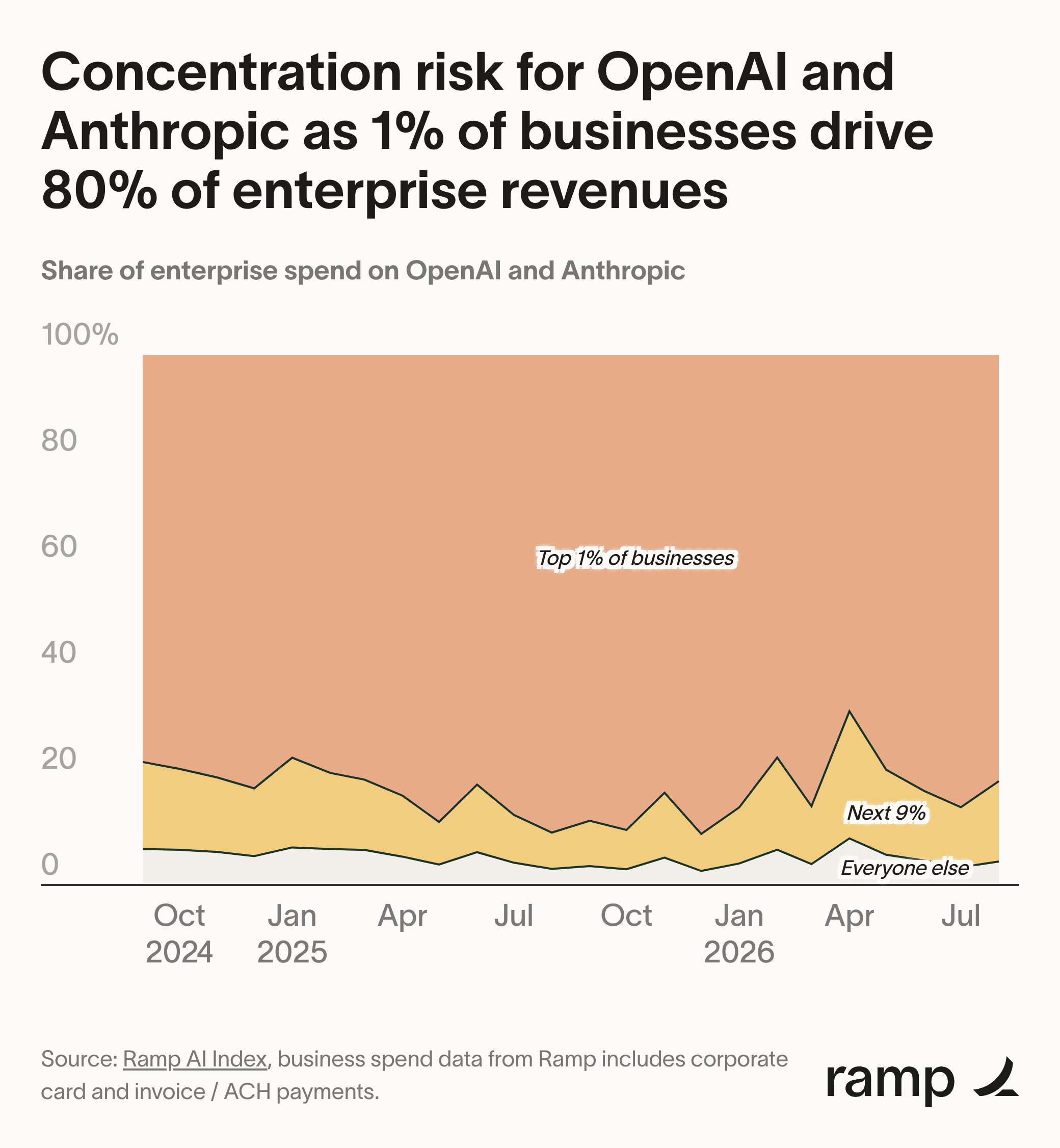
This degree of concentration is not unique to the models. A small number of buyers recur throughout the AI stack. But does a concentrated customer base necessarily give those customers power?
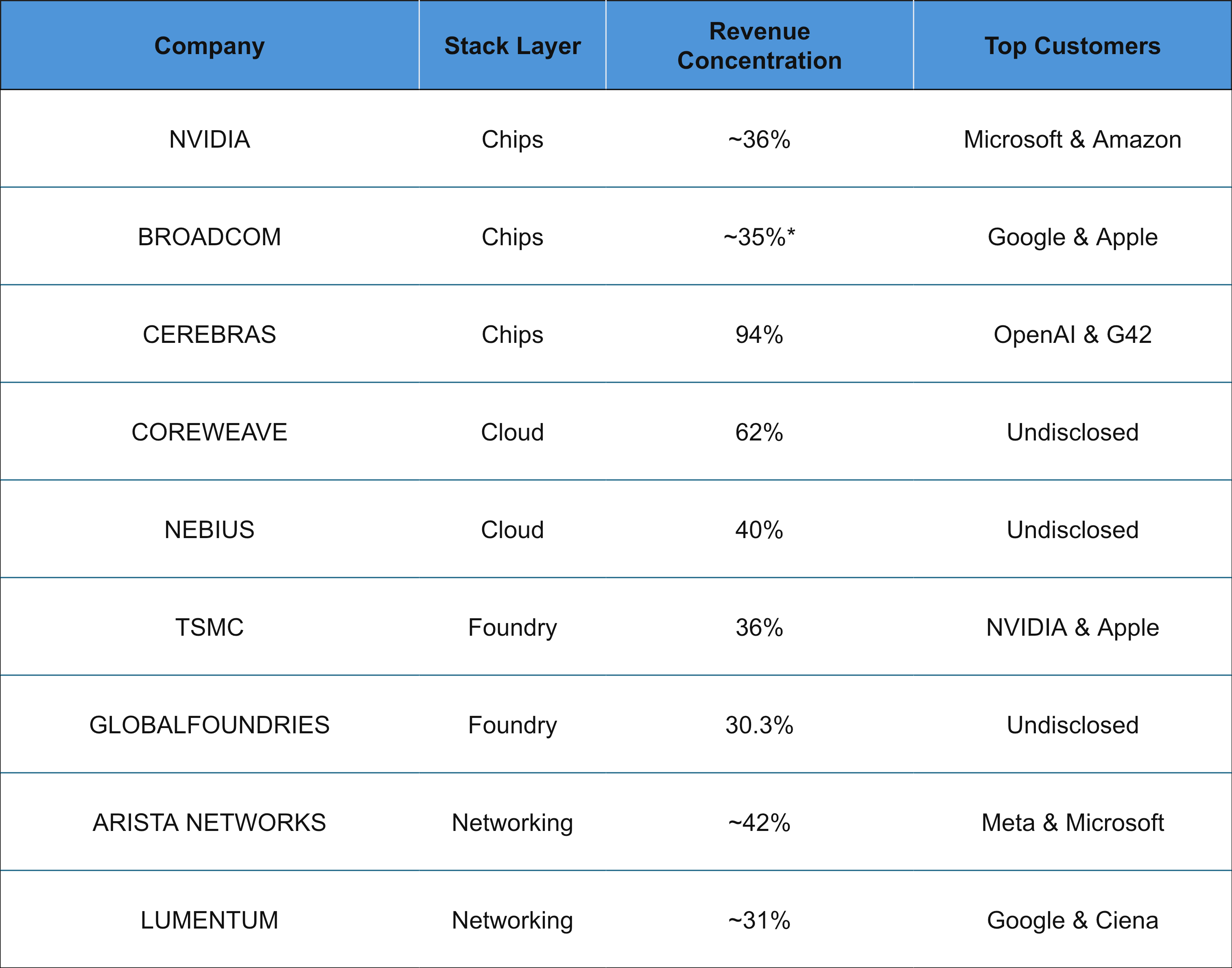
Let’s walk through a couple of examples each across different layers - the ratings below assess vulnerability to large customers switching suppliers, extracting concessions or reducing spending.
Models
Anthropic
Anthropic’s S-1 should drop in the next few weeks, which will give much more colour on customer concentration. Here’s what we know:
80% of revenue from B2B customers
6,000 accounts spend $100,000 or more annually
Grew from 500 to 1,000 accounts spending above $1 million in under
two months
Estimated NDR of 140%
Whilst we have the rough data point for the top 1%, we don’t have the share of the top 10 customers. Meta, rumoured to be a large customer of Anthropic (SemiAnalysis estimates 3-5%), has finally caught up to the frontier, posing a real risk of churning.
We’ll have to see the attach rate on Anthropic’s products beyond coding once the S-1 lands.
Concentration Risk: Medium
OpenAI
OpenAI has pushed out its IPO and therefore the data is more sparse:
>50% of revenue from enterprise, officially surpassed consumer, ahead of schedule
9 million business seats as of Februrary 2026
Codex is said to have somewhere between 15-20m WAUs
Advertising business now at $1bn run-rate
Q3 growth faster than Anthropic according to Ramp, albeit from a smaller base
Relative to Anthropic, OpenAI has a broader product portfolio and a more diverse revenue base.
Concentration Risk: Low
Fable 5’s limited adoption and increasing open source adoption suggest we’ve already past the threshold of intelligence needed for most tasks, which poses a real threat to the frontier model premium historically enjoyed by the labs.
On the other hand, Anthropic has a chance to expand beyond code and make the majority of knowledge work as legible as code has been to the scaling laws and RLVR (how else can you justify a rumoured $30 trillion TAM). Jevons Paradox will absolutely apply as token prices fall and adoption goes stratospheric.
Who will capture that incremental token spend remains unclear.
In a stable era like the one we’re in now, the enterprise and application-layer post-training market is maturing to a point where the majority of enterprise token spend could be reallocated towards an ecosystem of specialised models that offer a far lower cost per task than the models on offer from the frontier labs.
Chips
Nvidia
As long as the world is fragmented Nvidia wins; the only way its margins come under pressure is if there are a limited number of buyers who have the means to take only part of Nvidia’s stack or replace them completely.
Nvidia’s had a busy couple of weeks buying Huggingface and licensing Poolside’s model development factory. A natural consequence of concentration both ways for the labs and Nvidia is an effort to commoditise their complements.
For Nvidia, a thriving open source ecosystem is existential to their future, lest they end up with only 2 customers who are investing heavily in replacing them. It’s also why Nvidia started breaking out their Data Center revenue into 2 segments: hyperscale and ACIE, which incorporates AI Clouds, Industrial and Enterprise. ACIE customers such as neoclouds are Nvidia shops, whilst the hyperscale customers have the resources and incentives for custom silicon endeavours.
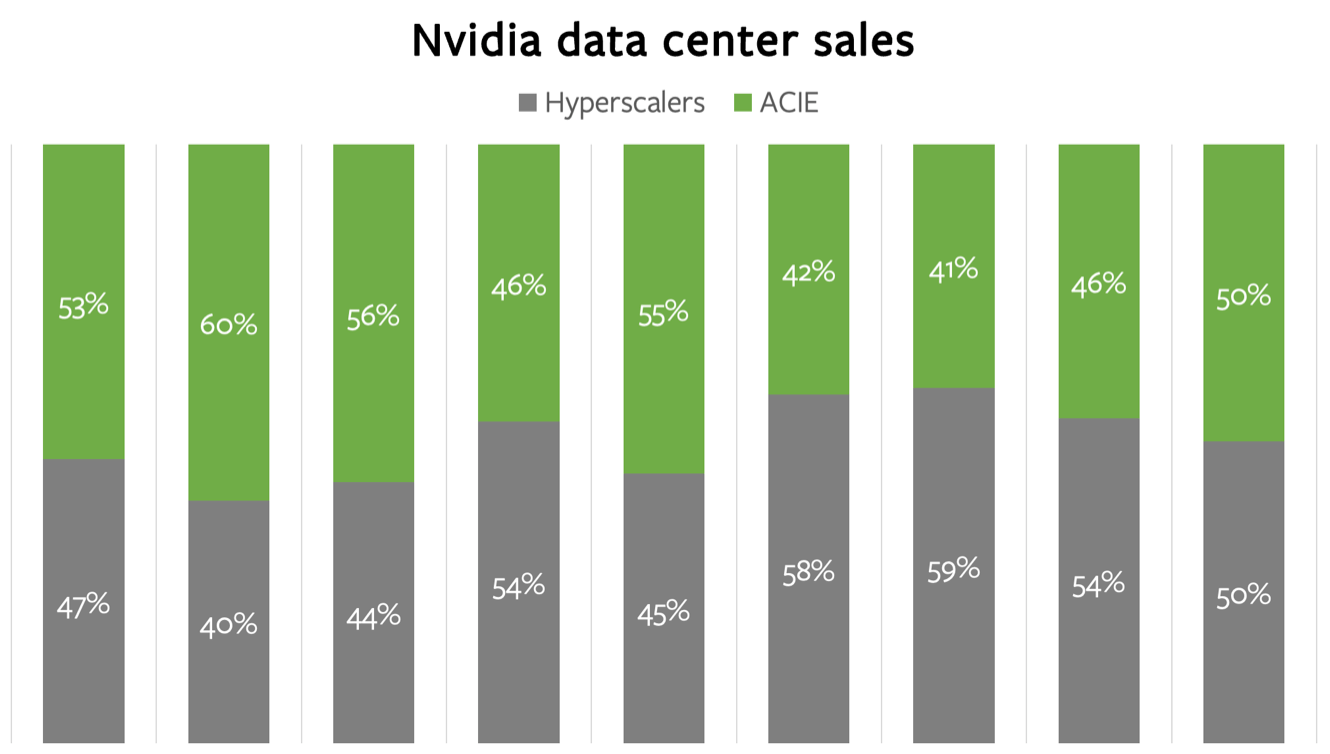
Nvidia’s grip on the inference market is much weaker than training. The Jalapeño results demonstrate the viability of custom silicon built around inference workloads, whilst AI-assisted EDA has already started to compress timelines to tape-out.
Google’s TPUs and Amazon’s Trainium are already serving the frontier labs, even if that says as much about how compute constrained the market is as about the quality of the chips. Microsoft’s Maia and Meta’s MTIA are further behind, but remain priorities.
Despite these efforts, Nvidia’s moat remains formidable, echoing the dominance Intel held during the days of its close integration with Windows, the Wintel duopoly.


The arrival of mobile was Intel’s undoing. Arm’s ISA was superior to CISC for low power mobile computing, and Intel failed to recognise this in time.
Will AI inference be Nvidia’s undoing?
It depends. Is AI inference that different to the deep learning workloads Nvidia has been serving since it released CUDA in 2006? In many ways it is, but is the gulf as large as the one between PCs and mobile that felled Intel?
The evolution of the revenue split between hyperscale and ACIE will be telling. Nvidia’s reference design for ‘synthetic hyperscalers’ is unlocking hundreds of billions of dollars in growth for ACIE segment.
Concentration Risk: Medium
Cerebras
Cerebras is one of many ASICs competing with Nvidia for inference share, and has a much greater concentration. G42 was its biggest customer by far leading up to its IPO, and in 2026 OpenAI and G42 will represent 94% of its revenue, with OpenAI expected to be the overwhelming majority in 2027 and 2028.
Compared to Nvidia, Cerebras is more concentrated in every way. Focused on inference more than training, serving 2 (soon 1) customer with the means and incentive to develop their own silicon, and limited evidence of a new customer cohort like ACIE. Much more reason to be worried.
Concentration Risk: High
Broadcom
Broadcom has a broader product portfolio including VMware and is not designing chips as co-designing and implementing hyperscalers’ custom silicon.
Semiconductors: $15.01B = 68% of revenue (up from 56% a year earlier)
Infrastructure software (VMware): $7.18B = ~32%
Within semis, AI is $10.80B = 72% of the chip segment, ~49% of the whole company. Networking is ~40% of that AI number ($4B+/quarter), custom XPUs the other ~60%.
Broadcom’s moat is process power.
Physical implementation must coordinate process rules, HBM, packaging, power, signal integrity, networking, validation, yield, and production schedules. Broadcom’s filings emphasize that major customer relationships can span years of collaborative development and accumulate customer-specific and system-level knowledge. A customer can switch implementation partners, but doing so introduces engineering work, schedule risk, validation burden, and lost accumulated learning.
Broadcom’s core competencies are non-core to hyperscalers’ custom silicon efforts.
Concentration Risk: Low
Cloud
CoreWeave
CoreWeave’s top 2 customers are 62% of revenue as of Q2. CoreWeave’s dependence on Microsoft and Meta was underlined when Microsoft was rumoured to be scaling back some of its commitments in the weeks leading to the IPO, causing widespread concern. OpenAI announced a $12bn commitment shortly afterwards, pacifying investors.
A consistent theme in recent Microsoft earnings calls is the notion of ‘fungibility’ of compute. The premise is that if the AI capex fails to deliver the expected ROI, the compute can be repurposed for other workloads. Microsoft itself can be a first-party customer for Azure, and in fact Azure’s growth is partially slowed down by Microsoft being a customer of its own compute. Microsoft also prefers to own rather than lease data centers, given their expertise in constructing data centers.
If compute is largely fungible, what are the implications for neoclouds like CoreWeave, which mostly run Nvidia fleets?
CoreWeave received a Platinum ranking on SemiAnalysis’ ClusterMAX leaderboard of neoclouds, higher than Nebius, OCI, Crusoe, Fluidstack and others. Beyond speed to power and the Nvidia relationship conferring early access to new silicon, this ranking ascribes value to CoreWeave’s PaaS offering for inference (also evidenced by MLPerf benchmarks).
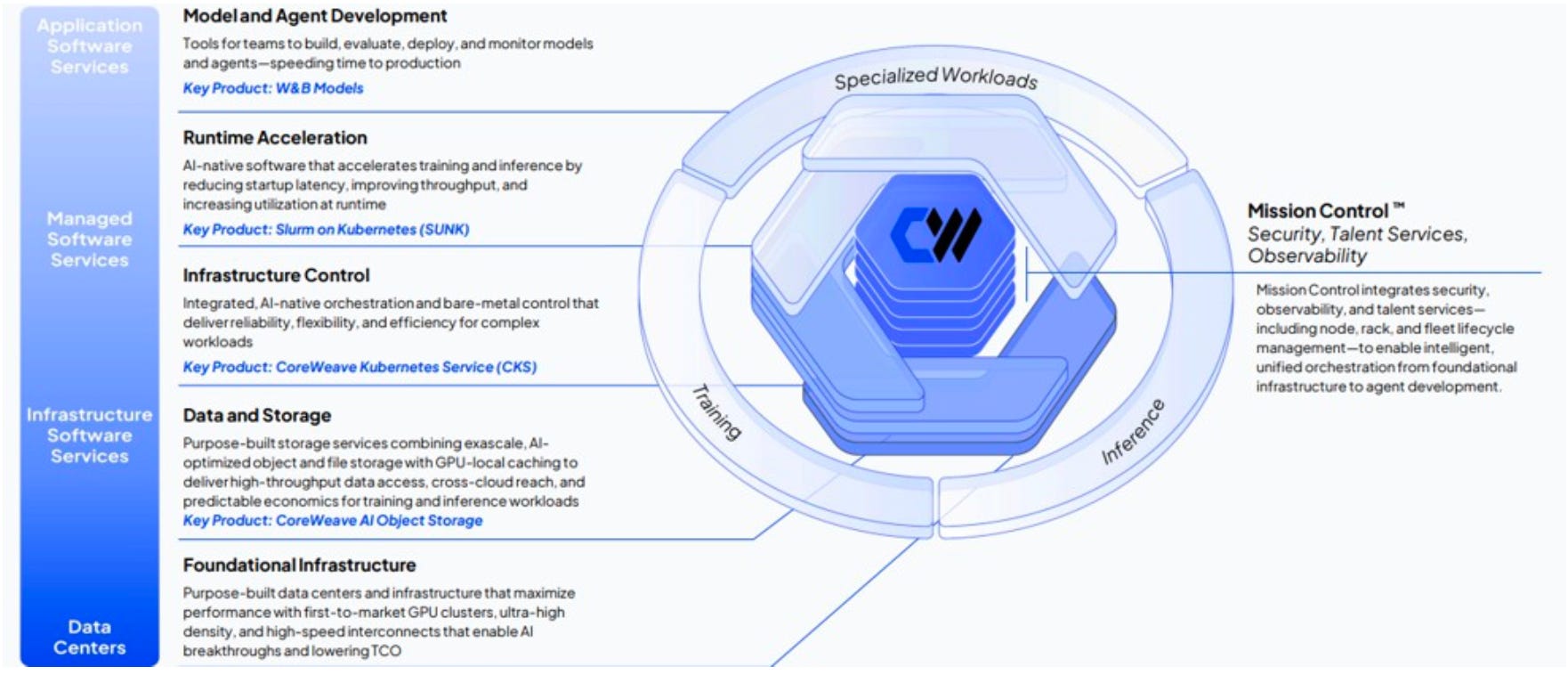
However, relative to other neoclouds, CoreWeave is far more concentrated and exposed to hyperscaler capital allocation. This risk is shared by all neoclouds, but CoreWeave especially so. Microsoft
Concentration Risk: High
Nebius
Like CoreWeave, Nebius has Microsoft and Meta as customers as well, but also counts enterprise like Shopify, Cloudflare and others as customers too.
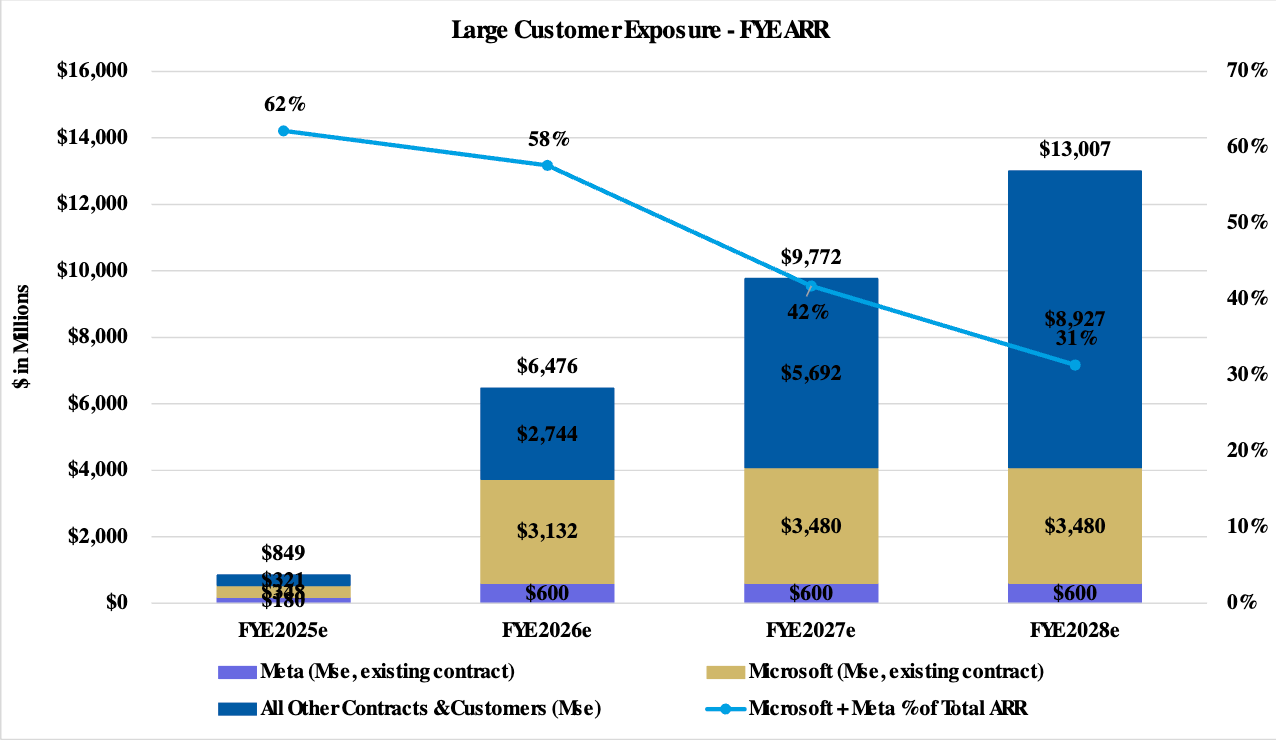
Nebius has a similarly compelling inference offering for AI workload, but given it’s origins from Yandex has even tighter optimisations across in-house-designed servers/racks.
The evolution of Microsoft/Meta share will be key.
Concentration Risk: Medium
Networking
Lumentum
The growth in model size and sparsity increase demand for scale up and scale out networking.
Lumentum is a key player in optical networking, supplying lasers used in optical transceivers and co-packaged optics. Google accounts for around 26% of revenue, with Microsoft and Amazon contributing roughly 8–15% each. Nvidia, Cisco and Ciena are also among its customers.
Like Broadcom, Lumentum’s moat is partly process power. Manufacturing advanced lasers requires specialised semiconductor facilities, accumulated manufacturing knowledge and consistently high yields. Designing your own accelerator does not automatically give you the capability to manufacture its optical components.
Lumentum has 50–60% share in leading-edge 200G electro-absorption modulated lasers, or EMLs. Customers put these components through reliability testing spanning multiple quarters.
Lumentum also has exposure across competing networking architectures. Conventional pluggable transceivers need lasers, as do emerging co-packaged optics, which bring optical connections closer to the processor or switch. The architecture can change without eliminating the need for Lumentum’s underlying capabilities.
The more immediate concentration risk is therefore spending, not substitution. Google does not need to learn how to manufacture lasers to hurt Lumentum’s growth; it only needs to delay deployments. And selling through equipment manufacturers does not necessarily diversify the underlying demand if those manufacturers ultimately serve the same hyperscalers.
Lumentum illustrates the distinction between customer concentration and customer bargaining power. Its buyers are concentrated, but so are the capabilities they need.
Concentration Risk: Medium
Arista
Microsoft and Meta accounted for 42% of Arista’s revenue in 2025, at 26% and 16% respectively. But unlike Cerebras, Arista has a credible route to adding another major customer.
Anthropic is the clearest candidate to cross 10% of revenue.
Anthropic uses Nvidia GPUs, Google TPUs and Amazon Trainium. Whilst those platforms have their own tightly integrated accelerator interconnects, operating across multiple platforms creates demand for a common networking approach elsewhere.
Custom silicon can therefore work in Arista’s favour. A customer moving away from Nvidia’s compute does not necessarily move away from Arista’s networking.
The moat is not Ethernet itself, which is an open standard. It is Arista’s EOS operating system and the operational consistency it provides across switching and routing hardware.
Arista’s concentration looks more manageable because it has both a defensible software layer and a plausible new customer cohort. The question is whether Anthropic becomes the first of many substantial new buyers, or simply the third name in another concentrated customer list.
Concentration Risk: Medium
Foundry
TSMC
TSMC is perhaps the clearest example of why customer concentration and customer power are not the same thing.
Its two largest customers accounted for 36% of revenue in 2025.
But the custom silicon efforts threatening Nvidia’s share can still generate business for TSMC. Google’s TPUs, Amazon’s Trainium and Nvidia’s GPUs compete for compute budgets whilst relying on the same foundry.
For Nvidia, fragmentation helps prevent a handful of customers from controlling its future. TSMC has a different advantage: it can manufacture for both the incumbent and the companies trying to replace it.
The moat is manufacturing process power at extraordinary scale. A customer needs more than a competing foundry with a similarly named process node. It needs sufficient capacity, competitive yields and a production process that can reliably deliver its design. Samsung and Intel have not yet matched TSMC’s combined leading-edge manufacturing and packaging capabilities.
TSMC does not necessarily need to capture every part of the manufacturing bill to benefit - TSMC welcomes competing packaging capacity because it removes constraints on its core wafer business.
Nvidia alone accounts for around 60% of CoWoS advanced-packaging capacity, with the top three customers exceeding 85%. Those are capacity estimates, not shares of total TSMC revenue.
If spending shifts from Nvidia GPUs to custom accelerators manufactured at TSMC, the foundry can retain the business. If spending on AI infrastructure falls altogether, there is no equivalent protection. Its customers’ exposure to the same downstream buyers still matters.
TSMC is better protected against a change in who wins the AI market than against a contraction in the market itself.
Concentration Risk: Low
Global Foundries
Global Foundries’ two largest customers account for 30% of wafer revenue.
Unlike TSMC, Global Foundries’ argument is not leadership at the smallest process node. It is specialised manufacturing for optical networking, power management, wireless connectivity and other functions where shrinking transistors is not the only measure of performance.
Whichever accelerator wins, the infrastructure still needs to move data and deliver power. GlobalFoundries can participate through silicon photonics and related technologies without having to manufacture the winning GPU or custom ASIC.
There are diversification opportunities in automotive, IoT, and communications infrastructure.
Concentration Risk: Medium
What happens when your customers succeed?
We usually think about customer concentration as the risk that a large customer fails, cuts spending or churns.
The hyperscalers and the frontier labs are the recurring actors throughout the AI stack. A lot is riding on their continued capex and top-line growth.
Ben Thompson’s Aggregation Theory offers part of the explanation for why the same buyers recur throughout the supply chain.
The platforms that won the customer relationship in the internet era enter this one with distribution, cash flows and workloads that support enormous infrastructure investments.
But the suppliers beneath them are not all interchangeable.
AI brings concentrated demand into contact with concentrated capabilities.
Inevitably, as the largest buyers scale, they gain both the resources and the incentive to develop alternatives to their suppliers. A customer can become more valuable to Nvidia whilst simultaneously becoming more capable of replacing it. Growth in the relationship does not necessarily result in retention.
Exposure to the hyperscalers and labs’ continued growth has unequal consequences. Custom silicon that challenges Nvidia can generate work for Broadcom and wafer demand for TSMC. The customer’s attempt to reduce one supplier’s pricing power becomes another supplier’s growth opportunity.
This is why concentration risk differs so much even between companies in the same layer. The important distinction is whether a supplier benefits from its customers’ growth, or becomes the target of vertical integration.
Everyone is exposed to aggregate demand slowing down, of course.