

There’s been a discernible shift in capital allocation from bits-based businesses to atoms-based businesses over the last few years.
The trillion-dollar AI buildout cast a sharp light on all the physical-world bottlenecks to inference - investors have been directing capital across these bottlenecks, from public markets to private markets and early stage venture capital.
Last year, Brett.Bivens wrote about The Rise of Production Capital, articulating the capital stack needs of the emerging cohort of atoms-based companies encompassing energy, manufacturing, space, robotics, and beyond.
The essay is worth reading in full:
From transport fleets (Zenobē) to digital infrastructure (CoreWeave) to energy storage (Base) to manufacturing (Hadrian) to clean fuels (Twelve) to aerospace (ISAR) – debt is playing an increasingly key role in the capital stacks of the most promising emerging companies. For companies deploying valuable hard assets – batteries, modular robotics, CNC machines – asset-based lending is emerging as the wedge to unlock scalable project and equipment-level finance, allowing these companies to grow at venture speed while consuming far less equity capital.
These hard asset businesses are increasingly built and valued on bundles of cash flows rather than revenue multiples, requiring an entirely different approach to capital formation across the company lifecycle. And while several early movers have begun to break through, the holistic financing models best suited to systematically support and scale this model remain fragmented and underdeveloped.
Optimally constructed, the progression often looks something like initial venture equity for R&D and product development, followed by targeted asset-based debt that serves as a wedge to unlock project-level financing once the core technology demonstrates commercial viability. As deployment scales, warehouse facilities or securitization structures become critical to efficiently finance multiple deployments simultaneously, allowing companies to recycle capital without returning to the venture markets. These securitization structures transform illiquid hardware assets into tradable securities with predictable cash flows, dramatically expanding the pool of available capital beyond traditional venture sources.
I’ve been thinking about this a lot lately, but only the theory of it all.
Fortunately, there are plenty of recent examples that impart clear lessons on how capital stacks evolve to help technologies climb Technology Readiness Levels.
Energy
Fervo
Fervo makes geothermal power where conventional geothermal doesn’t work. It drills horizontal wells into hot, dry rock and fractures them to create a reservoir, using techniques from shale oil and gas.
The pitch is repeatability: standardised GeoBlocks, drilled in the same basin, riding the same learning curve that made shale cheap.
Fervo is working to build a different type of energy company—one that treats each geothermal power facility as a repeatable product, not a one-off, complicated project.
Tim Latimer, CEO, letter in the IPO prospectus
Founded in 2017, by Tim Latimer and Jack Norbeck.
The flagship site is Cape Station in Beaver County, Utah:
Pilot: Project Red in Nevada produced 3.5MW in July 2023, the first enhanced geothermal system built with horizontal wells.
Phase I: ~100 MW across three GeoBlocks, contracted with Southern California Edison, Shell Energy and community choice aggregators. GeoBlock 1 declared commercial operation on 30 September 2026, one day ahead of its contractual date, at 33 MW net.
Phase II: ~400 MW targeted for 2028, with about $2.2 billion of capex expected through 2028.
Google signed a 396MW PPA for it in September, with an option on ~600MW more by June 2030.
Contracts: 658MW of binding PPAs at Q2, with ~15 years remaining and $7.2 billion of revenue backlog. Buyers include Southern California Edison, Shell and two California community choice aggregators. With Google, binding PPAs passed 1GW in October.
Costs: ~$7,000/kW for Phase I, a ~$5,500/kW target for Phase II and $3,000/kW long term. The average US gas plant built in 2025 cost $2,157/kW.
Drilling: the ninth well on its current design reached ~19,500 feet in 21 days, a company record.
Commercialisation: Fervo is a construction business. Q2 revenue was $113,000. Q2 capex was $226.5 million.
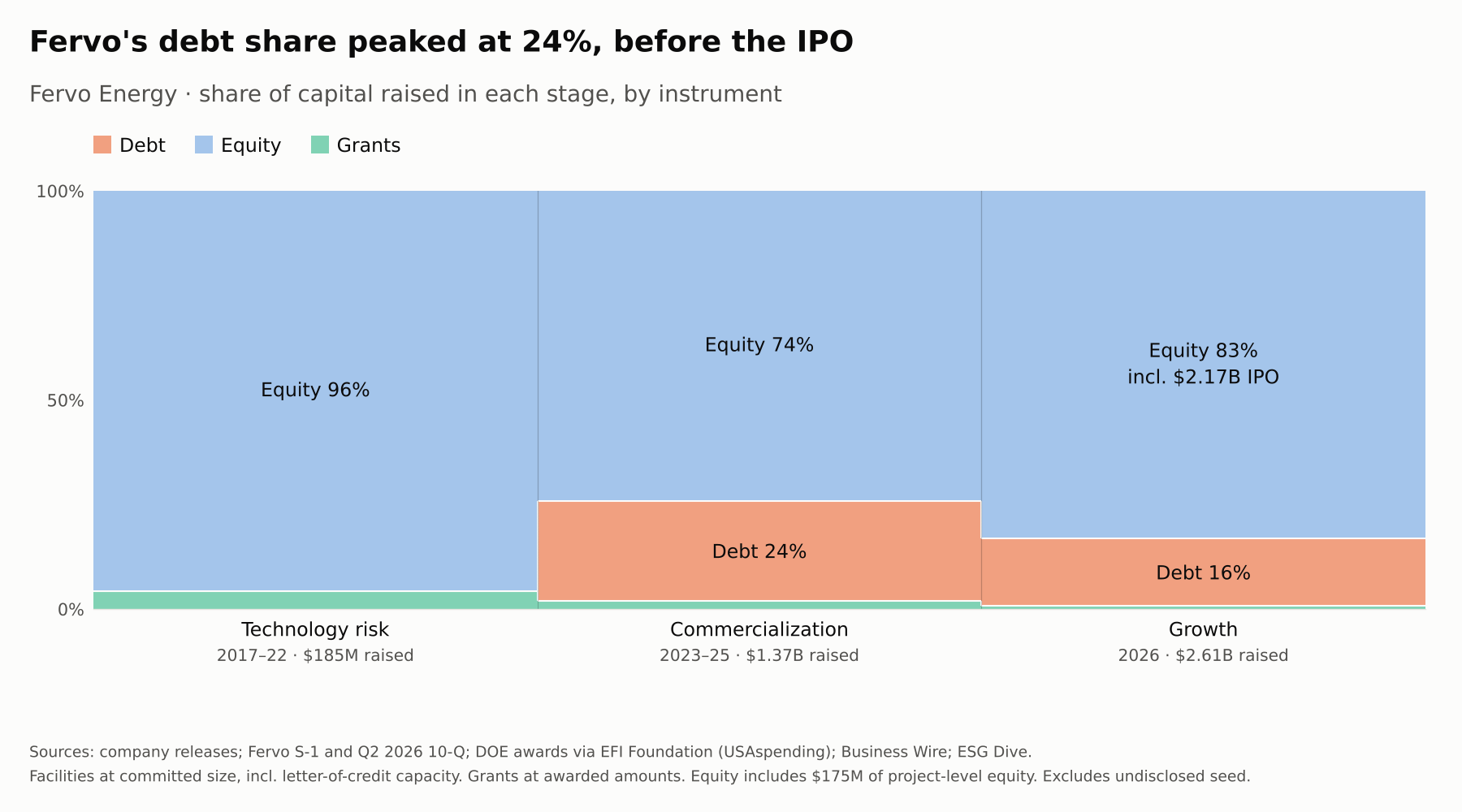
Stage One: Technology Risk (2017-2023)
The early stack was venture equity plus non-dilutive government money.
Series A, B and C came to ~$177m.
DOE and ARPA-E awarded roughly $7.9 million across four awards between 2018 and 2022.
Stage Two: The Bridge Years (2023-2025)
Cape Station needed cash before it could carry bank debt. Fervo filled the gap with every instrument available. This is where the Production Capital framing gets interesting.
Between the pilot and access to wider credit markets sits a band of expensive, bespoke capital:
2023 convertible note: $10 million from a >10% holder at a 3.1% coupon and a 15% conversion discount. Ten months later it converted into $12.0 million of Series D-2.
Series D-1 (February 2024): $3.52 per share, flat to Series C despite Project Red’s results. That was the cost of equity before Cape had a lender.
XRC bridge (August 2024): $100 million, upsized to $145.6 million, from a “micro-rural” construction lender at prime + 3.5% with an 11% floor. It also carried a prepayment premium and sponsor guaranties, including a construction completion guaranty.
Mercuria term loan (November 2024): $40 million, later $100 million, plus an $80 million letter-of-credit facility. Pricing: SOFR + 0.10% + 7.50% with a 3% floor, a 1.5% upfront fee and a 2% commitment fee on undrawn amounts. Covenants include debt to equity contributions of no more than 0.6x.
Stage Three: Project Preferred, Two Prices
Two project preferred tranches at Cape Phase I - same project, a few months apart, at very different prices.
Breakthrough Energy Catalyst ($100 million, June 2025): a 5% per annum preferred yield, compounding, with cumulative distributions of ~$139 million on an amortising profile through 2041.
Centaurus ($75 million junior preferred, October 2025): a cash waterfall to a 12.5% IRR flip (12% if no term debt is raised), then a $5/MWh royalty starting 15 years after final completion. It also came with warrants over 2.55 million shares at $7.34.
The Catalyst financing is structured as project-level preferred equity with a priority dividend and return-of-capital profile, with cash applied first to preferred distributions before amounts are available to common equity.
Fervo IPO prospectus
The gap between 5% and 12.5%-plus-warrants is the price of seniority.
Stage Four: Bankability (March 2026)
Project Granite is the moment the asset crossed into bank-financed infrastructure.
It is a $421.4 million package: a $309 million construction-to-term loan, a $61 million tax-credit bridge and $51 million of letters of credit. The coordinating lead arrangers were Barclays, BBVA, HSBC, MUFG, RBC and Société Générale, joined by BofA, J.P. Morgan and Sumitomo Mitsui Trust.
The terms:
Construction and term loans: SOFR + 3.00%, stepping to 3.125% and then 3.25% from the third and fourth anniversaries.
Tax-credit bridge: SOFR + 2.375%.
Commitment fees: 30% of the applicable margin.
Tenor: a five-year mini-perm, maturing in March 2031.
Sizing: the lesser of a 1.50x minimum DSCR on the P90 production forecast and 75% of total project costs.
Against Mercuria’s 7.60% over SOFR, that is roughly 460bp of spread compression in 16 months.
Non-recourse financing has historically been considered out of reach for first-of-a-kind projects. Cape Station disrupts that narrative.
David Ulrey, CFO
Stage Five: The IPO
$2.17 billion raised in May 2026.
The IPO price was 2.4x Series E per share, five months later.
Lessons
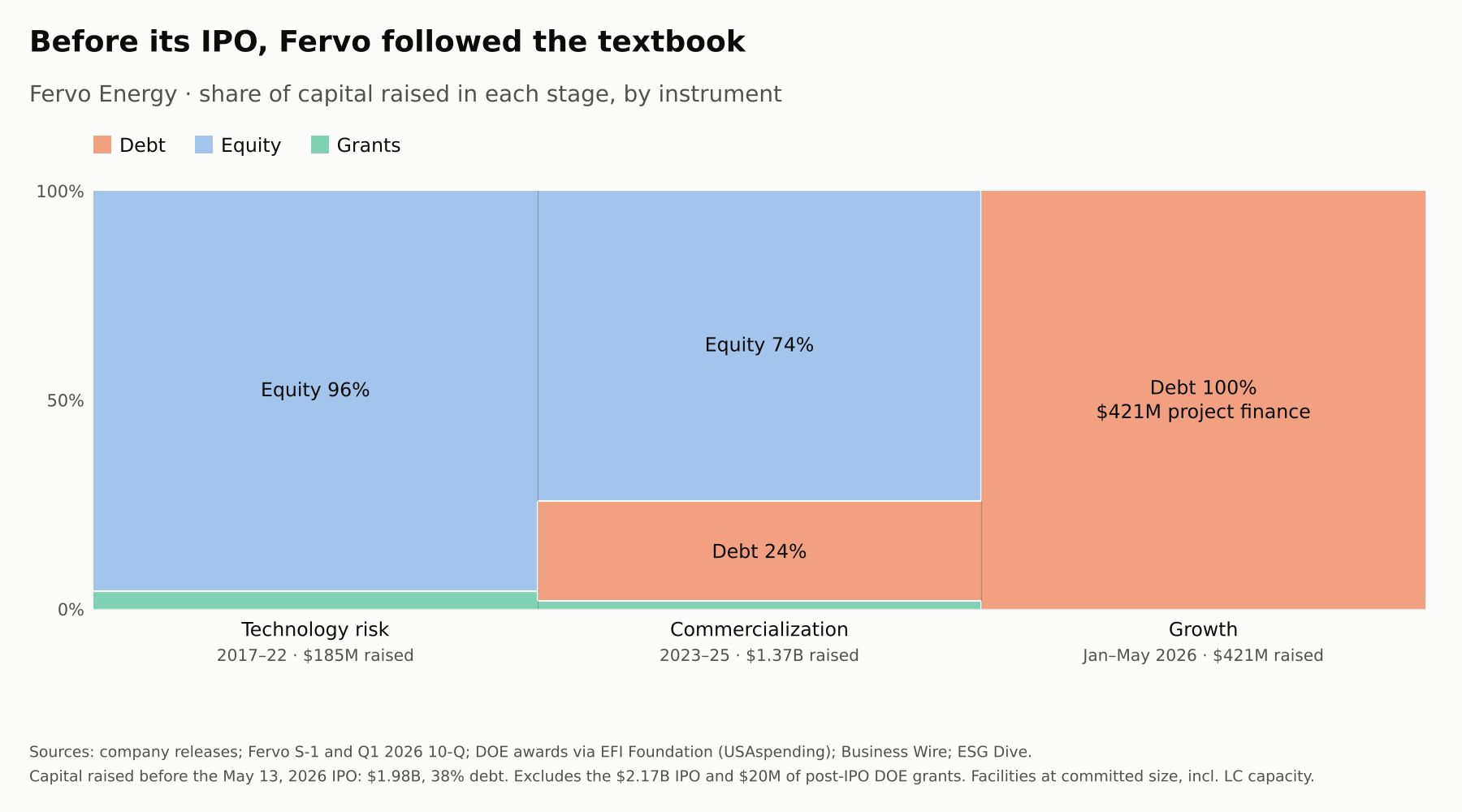
If you remove the IPO proceeds, the evolution of the capital stack is striking.
Before listing, Fervo raised ~$1.98 billion: 60% equity, 38% debt and 2% grants. Stage by stage, debt went from 0% to 24% to 100%.
Breakthrough Energy is the closest thing Fervo had to the orchestrator Brett Bivens describes in his essay.
Breakthrough Energy Ventures held the equity from the early rounds. Breakthrough Energy Catalyst then wrote 5% project preferred that sat between bridge debt and bank debt.
Three lessons:
Contracts are the collateral. Every debt layer was lent against signed PPAs, not the technology. Project debt is priced off the buyers, like with neoclouds.
The bridge years are expensive and bespoke. A rural construction lender, a commodity trader and a climate fund (not banks) carried Cape from pilot to lower cost of capital.
Cost of capital falls in steps, each tied to a retired risk. Spreads compressed ~460bp in 16 months as construction progress and P90 data replaced promises.
Manufacturing
Hadrian
Founded in 2020, by Chris Power, Hadrian builds highly automated factories for precision parts, and increasingly whole assemblies, for space and defence programmes. Software and robotics let a technician with no machining background become productive in about 30 days, so a new factory can go from lease to production in roughly six months.
Hadrian runs four factories: Hawthorne, Torrance, Mesa and, since March 2026, Cherokee, Alabama. Cherokee is the one that matters for this analysis. It is a 2.2 million sq ft former railcar plant building Columbia- and Virginia-class submarine components, with the Navy as both end customer and co-investor. Full-rate production on the first phase is expected within 24 months. It is the first Hadrian factory large enough, and contracted enough, to be financed on its own merits rather than off the company’s balance sheet.
The business is sold as “Factories-as-a-Service” to defence primes.
Stage One: The Venture Factory (2020-2024)
Three venture rounds built the first two factories in Hawthorne, Torrance.
Seed (April 2021): $9.5 million from Lux Capital, Founders Fund and Construct Capital.
Series A (March 2022): $90 million, led by Lux Capital and Andreessen Horowitz, with Founders Fund participating.
Series B (February 2024): $117 million “in a mix of equity and debt”. Roughly $92 million of equity (CNBC) and around $25 million of debt for equipment and expansion. RTX Ventures, the venture arm of a prime, joined.
That ~$25 million is the first debt in the stack.
Stage Two: Debt Enters With The Equity (2025-January 2026)
The Series C was the first time a bank sat alongside the venture investors.
Series C (17 July 2025): a $260 million package. WSJ reported the equity portion as $110 million, led by Founders Fund and Lux Capital, with Altimeter and 1789 Capital new.
Morgan Stanley factory expansion loan (July 2025): arranged by Morgan Stanley alongside the round. The size was not disclosed; the WSJ split implies ~$150 million. Coupon, tenor and security are not public.
Extension (9 January 2026): an undisclosed amount at a $1.6 billion valuation, led by T. Rowe Price, with Altimeter, D1, StepStone and 1789 Capital.
Stage Three: The Navy As Customer And Investor (March 2026)
This is where the government enters the capital stack.
US Navy partnership (20 March 2026): $900 million of Navy funding through appropriations, conditional on more than $1.5 billion of Hadrian’s private capital going in first. The Navy’s money is “grounded in demonstrated performance”.
Alabama abatements (2026): $34.8 million from the state and ~$10.4 million from the county. These are tax abatements, not cash.
More than $1.5 billion in capital from Hadrian comes in first. The Department of the Navy follows with a commitment of $900 million to scale up the factory... Risk is shared. Performance is required...
- John C. Phelan, Secretary of the Navy
Government capital is being structured as performance-gated co-investment, not a grant. The $900 million is less a funding source than a commitment device: it gives private investors a sovereign anchor (the Navy is also the end customer), while making sure the taxpayer’s money is the last in, not the first.
Stage Four: The Big Equity, Then The Revolver (August 2026)
Series D (6 August 2026): $1.37 billion at a $7.87 billion valuation. JPMorganChase’s Strategic Investment Group joined as anchor co-lead; Morgan Stanley Wealth Management also took part.
Revolving credit facility (14 August 2026): $360 million. Morgan Stanley Senior Funding was lead left arranger and bookrunner, with Western Alliance, J.P. Morgan, First Citizens, Customers Bank, HSBC Ventures USA, Axos and Texas Capital as joint lead arrangers. Use: “advanced manufacturing infrastructure, machinery, and related hardware”.
The revolver is corporate, not factory-level debt. Lenders took the credit after a $1.37 billion equity cushion, not against a single factory’s cash flows.
Lessons
Capital stack evolution:
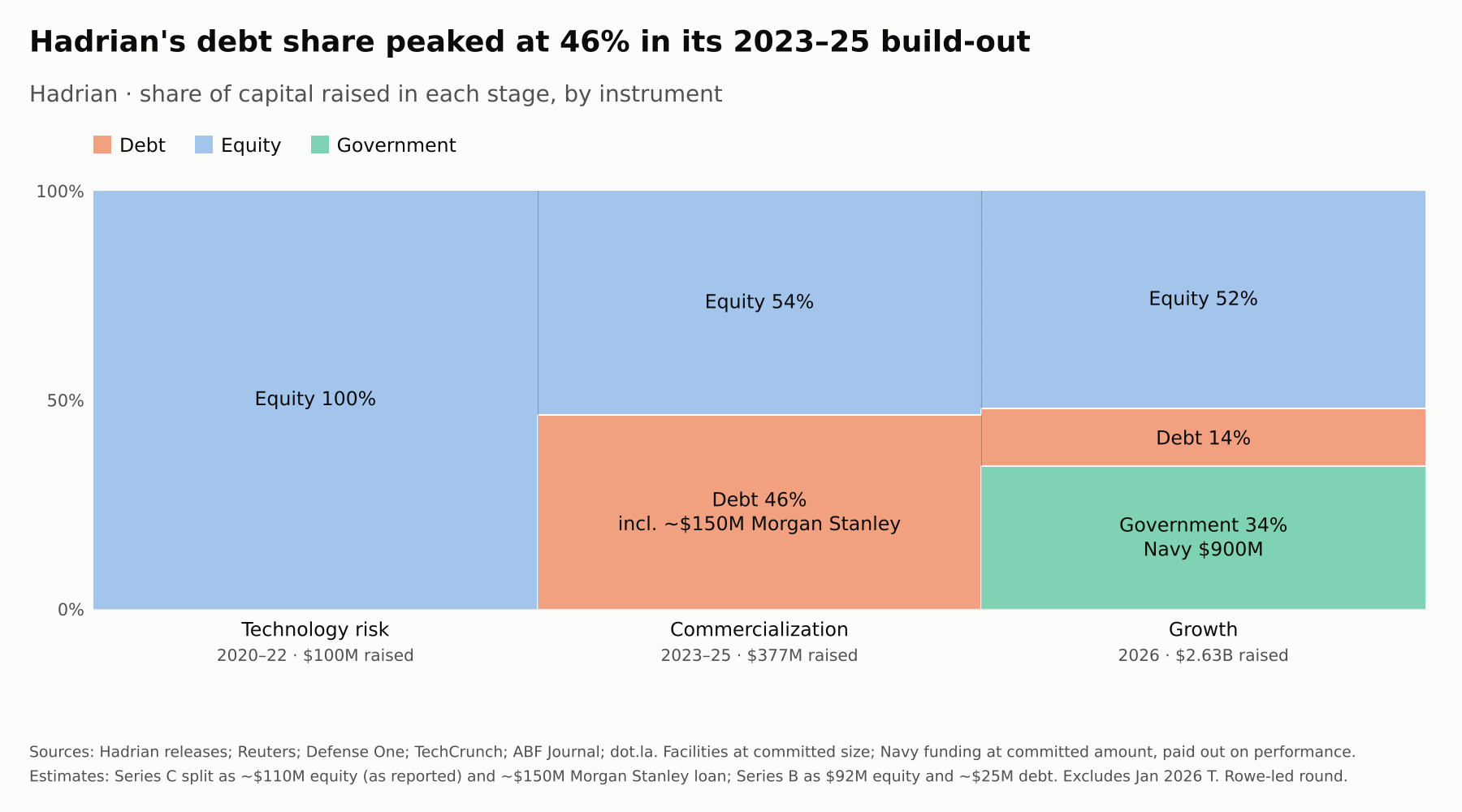
Morgan Stanley appears in three layers: the Series C loan, the Series D (through its wealth arm) and the revolver. JPMorganChase sits in both the Series D and the revolver.
Those are banks with both an equity desk and a lending desk, hence they’re the closest thing to the orchestrators in Hadrian’s case.
Three lessons:
Debt arrived as a companion to equity. Every debt layer (2023 equipment debt, the 2025 factory loan, the 2026 revolver) landed alongside an equity round.
The equity cushion is the collateral. Until a single factory has a cash-flow history, lenders underwrite the corporate balance sheet, so the cost of debt depends on how much equity sits underneath it.
Public capital can be written to come second. Private capital takes the first loss, and the state comes in only once that capital is committed and the factory is delivering.
Today every dollar of Hadrian’s debt is corporate, priced off the equity beneath it.
Cherokee could change that. A factory with a sovereign customer and a production record is something lenders can underwrite on its own, so the next layer of the stack can be raised factory by factory, the way Fervo funded Cape Station Phase I against its power contracts. If Cherokee hits full rate on schedule and the Navy’s money flows on performance, Hadrian moves from borrowing on its equity to borrowing on its factories.
Space
Rocket Lab
Rocket Lab is a vertically integrated space company: it owns the launch vehicle, the spacecraft and most of the subsystems inside it. Launch is the visible half. Electron is the workhorse for dedicated small-satellite missions, HASTE adapts it for suborbital hypersonic testing for the Pentagon, and Neutron, a reusable medium-lift rocket still in development, is its bid for the constellation and national-security market that Falcon 9 dominates.
Space Systems is the larger and less visible half. Rocket Lab designs and builds complete spacecraft, from its Photon platform to the 36 satellites it is delivering to the Space Development Agency. It is also a merchant supplier of the parts that go into other companies’ satellites: solar power, attitude control, flight software, and through acquisitions, infrared payloads (GEOST) and laser communications terminals (Mynaric). The capability was largely bought. SPAC cash funded the first wave: ASI (flight software) and Planetary Systems (separation systems) in 2021, and SolAero (solar power) in 2022. The second wave was paid for with cash raised from share sales: GEOST (infrared payloads) in 2025, then Mynaric (laser communications) and Motiv (space robotics) in 2026. Space Systems was 75% of revenue in H1 2026.
Peter Beck founded the company in New Zealand in 2006. It listed on Nasdaq via a SPAC in August 2021.
The flagship product is Neutron and its pad, Launch Complex 3 at Wallops Island, Virginia. Neutron is a reusable rocket that can carry ~13,000 kg to low Earth orbit. It has cost about $360 million of R&D and capex by end-2025, heading to ~$400 million at first launch, against an original $250–300 million estimate.
A Stage 1 tank ruptured in testing in January 2026, and first launch slipped to Q4 2026 with the “window for an end-of-year launch date narrowing” (Q2 10-Q). It cannot bid for National Security Space Launch task orders until it has flown successfully.
Neutron is the test case. Customers won’t prepay and lenders won’t lend against a rocket that hasn’t flown - customers funded Space Systems. Neutron has been funded by shareholders, directly or through a convert that became equity.
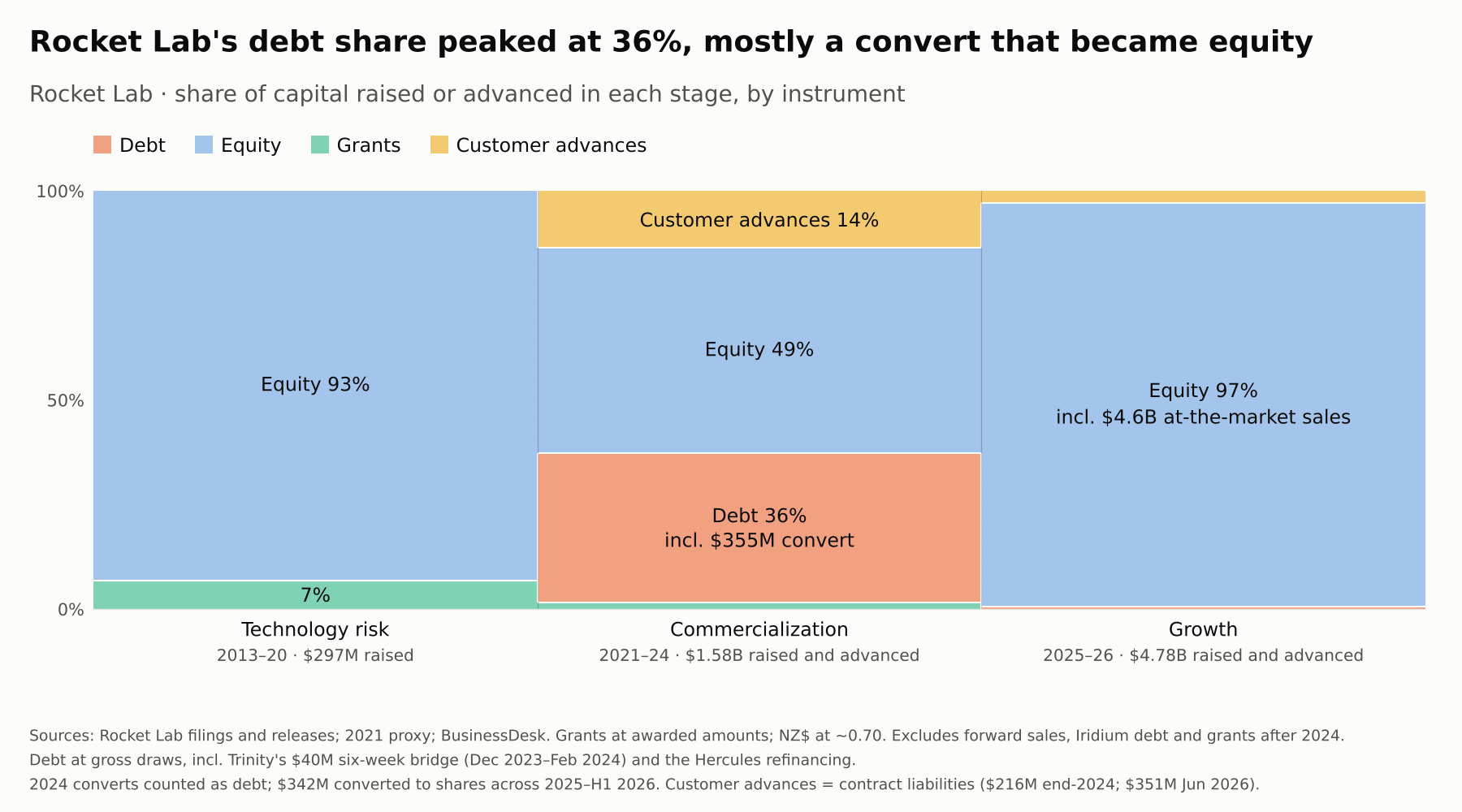
Stage One: Grants And Venture (2013-2020)
New Zealand’s R&D subsidy made each venture dollar go further.
Callaghan Innovation growth grant (2013-2020): 20% co-funding of eligible R&D, capped at NZ$5 million a year. NZ$29.2 million in total.
Series A (late 2013): Khosla Ventures. ~$5.5 million.
Series B (March 2015): led by Bessemer, with Khosla, K1W1 and Lockheed Martin as a strategic investor. ~$21.5 million.
Series C: ~$16.5 million.
Series D (March 2017): $75 million led by DCVC, with Promus, Bessemer, Khosla and K1W1, at a valuation “in excess of $1 billion”.
Series E (October 2018): ~$138 million. Australia’s Future Fund wrote $100 million of it.
Series E-1 (May 2020): $20.5 million.
The big repricing came between Series C and D. After that, the valuation has stayed relatively flat, while Electron went from test flights to commercial launches.
Stage Two: The SPAC And A Venture Loan (2021-2022)
Hercules Capital term loan (June 2021): $100 million, secured on substantially all assets, at the greater of 8.15% and prime + 4.90%, plus 1.25% PIK. That is at least 9.4% before fees.
Vector Acquisition merger (August 2021): $310 million from the SPAC trust plus a $467 million PIPE at $10.00, anchored by Vector Capital, BlackRock and Neuberger Berman. That made $777 million gross and $728 million net.
Acquisitions paid for with SPAC cash: ASI ($40 million), Planetary Systems (~$42 million plus stock) and SolAero ($80 million).
The PIPE price was ~2.9x Series E per share, ten months after a flat round. The Hercules loan bridged to the listing, and the listing cash paid for the roll-up of component makers.
Stage Three: From Venture Debt To Converts (2023-2025)
Trinity Capital equipment financing (December 2023): up to $120 million over 60 months, about 12% a year, plus warrants. Part of it repaid Hercules.
Convertible notes (February 2024): $355 million of 4.25% senior unsecured notes due 2029, convertible at $5.13 per share.
Exit: Trinity was repaid in December 2025, and $341.6 million of the notes converted into ~66.7 million shares by 30 June 2026, leaving $13.4 million outstanding.
The 4.25% coupon was not a tighter credit spread. Holders were paid with an equity option struck at $5.13, so the convert was a deferred equity raise.
Grants: CHIPS Act (November 2024) grant of up to $23.9 million for SolAero’s Albuquerque line, paid against milestones. Rocket Lab had to commit at least $32 million of equity and accept limits on buybacks and dividends.
Stage Four: Customer Prepayments (2023-2026)
Fixed-price government contracts brought in the cash that would otherwise have come from lenders - used to pay for contract costs within a one-year period:
SDA Tranche 2 Transport Layer (December 2023): $515 million for 18 satellites.
SDA Tranche 3 Tracking Layer (December 2025): $816 million for 18 satellites, delivering in 2029.
Contract liabilities (money billed to customers before the work is recognised as revenue): $139 million at end-2023 and $351 million at 30 June 2026. Customers advanced or were billed $207 million in H1 2026 alone.
Backlog: $2.36 billion at 30 June 2026.
Stage Five: The At-The-Market Factory (2025-2026)
Once the share price moved, the at-the-market (ATM) programme, which sells new shares into the market over time, became the main source of capital.
March 2025: $397 million at ~$26 a share.
September 2025: $749 million at ~$48.
March 2026: $474 million at ~$70, plus collared forward sales worth $474–642 million to settle in 2028.
May 2026: $1.06 billion at ~$136.
August–September 2026: $1.94 billion at ~$66, through Deutsche Bank and Wells Fargo.
Stock was also used as acquisition currency: GEOST, Mynaric and Motiv.
That is ~$4.6 billion of ATM sales in about 18 months, against $777 million from the SPAC. Cash went from $271 million at end-2024 to $2.13 billion at 30 June 2026.
Stage Six: Iridium Acquisition, Bridged By Equity (2026)
Iridium merger (June 2026): $27 in cash plus Rocket Lab stock per Iridium share, about $8 billion of enterprise value. It needs more than $3 billion of cash.
Iridium runs a constellation of 66 low-Earth-orbit satellites that provides voice and data coverage anywhere on the planet, including the oceans and poles. Its customers are ships, aircraft, IoT devices and the US Department of Defense.
For Rocket Lab, it’s an existing constellation with recurring revenue, bought rather than built.
Bridge loan: Deutsche Bank and Wells Fargo provided a $3.6 billion 364-day secured bridge, which was cancelled undrawn on 15 September 2026.
Iridium credit amendment: Iridium’s lenders agreed to the deal, so $1.775 billion of its term loans stay in place at SOFR + 2.50–3.00%.
Deal hasn’t closed, expected mid-2027
Lessons
Rocket Lab’s financing mix of $6.7 billion: ~85% equity, ~9% debt, ~1% grants and ~5% customer capital. If you count the converted notes as the equity they became, debt falls to ~4%.
Stage by stage, debt went from 0% to ~37% and back to ~0%. That 37% peak was mostly a convertible that turned into shares.
Compared to Fervo and Hadrian, there aren’t any clear production capitalists in the case of Rocket Lab. However:
The US government: SDA’s fixed-price contracts brought in advances and backlog, and the CHIPS award came with a covenant requiring Rocket Lab to put in equity.
Deutsche Bank and Wells Fargo wrote the $3.6 billion bridge and ran the share sales that retired it for the acquisition of Iridium
It wasn’t possible to build a lending stack on Neutron. Yet.
Three lessons:
Debt was priced off the equity, not the assets. Secured lenders charged 9.4% (Hercules) and then about 12% plus warrants (Trinity). Cheap money, at a 4.25% coupon, arrived only with an option on the shares attached, and most of those notes became shares.
Customer capital funds what customers buy. SDA prepaid the spacecraft business. A rocket with no flight history can’t be prepaid or lent against, so Neutron’s ~$400 million has come largely from shareholders.
A high share price is a way to raise money, and it rises and falls with the market. $4.6 billion of share sales, stock-paid acquisitions and the equity takeout of the bridge all depended on the share price. The biggest raise, $1.94 billion, came at about half May’s ~$136 average.
Conclusions and further analysis
The customer’s credit is the collateral
In the stacks that reached cheap debt, it arrived when a creditworthy buyer signed a long-term contract, so lenders could look through the company to the customer.
Lend against it. Fervo’s Granite facility is sized at 1.5x debt service cover on P90 output, all of it sold to Southern California Edison, Shell and two community choice aggregators. It prices at SOFR + 300. Google’s 396MW PPA will be the collateral for Phase II.
Take it upfront. The Space Development Agency’s fixed-price contracts gave Rocket Lab $351 million of customer advances by June 2026 - that is working capital spent on the satellites, not financing for Neutron.
Have the customer invest. The Navy committed $900 million to Hadrian’s Cherokee factory, which makes parts for its submarines. Google, Fervo’s largest buyer, invested in its Series E.
This is the neocloud mechanism. CoreWeave borrows at ~5.9% against Meta’s contract and ~9% against itself. Fervo’s spread fell 460bp in 16 months, from a corporate loan at SOFR + 760 to project debt secured on its PPAs.
It works for any business whose output can be sold forward to a creditworthy buyer: power, compute, satellites, submarine parts. It fails where the output can’t be sold before it exists. Nobody has prepaid for, or lent against, a Neutron launch.
Neocloud debt also lands at a similar price once a strong buyer is involved: Nebius’s facility is priced at SOFR + 250, against Granite’s SOFR + 300.
It has two limits. First, customer capital funds what customers buy, so nobody prepays for, or lends against, a rocket that hasn’t flown. Second, the loan has to be repaid within the contract unless the asset outlives it. GPU lenders assume the chips are worth little once the contract ends, so they want their money back within its term. Fervo’s wells keep producing after the PPA ends.
Debt follows contractibility, not technology readiness.
Asset-Level Debt Needs an Asset That Can Stand Alone
Debt priced off the parent’s balance sheet is expensive, because it is priced off the equity cushion beneath it. Debt priced off an asset’s own cash flows is cheaper, under the right conditions.
Of the three companies, only Fervo moved from corporate to asset-level borrowing.
It could, because Cape Station Phase I stood on its own: a ring-fenced project, contracted output, production data and a construction schedule lenders could underwrite.
Fervo crossed. It went from corporate bridges to non-recourse project debt at SOFR + 300, roughly 460bp cheaper in 16 months.
Hadrian hasn’t yet. Every layer of its debt, up to the $360 million revolver, is corporate.
Rocket Lab never did. Secured lenders charged 9.4% and then about 12% plus warrants. Its cheapest money was a 4.25% convert that became shares.
The conditions for crossing:
A separable asset.
A creditworthy buyer under contract.
Completion risk retired.
Operating data a lender can haircut, like P90 production.
An asset that outlives its contract.
Standardisation is what makes it repeatable: one GeoBlock is the template for the next.
Rocket Lab’s first asset-level debt will be bought, not built. If the Iridium deal closes, it inherits $1.775 billion of term loans at SOFR + 250–300. That is Granite’s price, for a constellation that already earns recurring revenue.
Asset-level money isn’t cheap by default. Granite is capped at 75% of project cost and must be refinanced within five years. Getting there needed a layer in between: Fervo paid 5% for senior project preferred and 12.5% plus warrants for junior.
Four conditions decide the move: a separable asset, a creditworthy buyer, performance data and covered construction risk. Hadrian’s Cherokee is the closest of the rest to meeting all four.
Government plays at least six roles
Grants: DOE and ARPA-E (~$7.9 million to Fervo), Callaghan (NZ$29.2 million to Rocket Lab), and CHIPS (up to $23.9 million for SolAero).
Customer: SDA ($1.33 billion across two tranches), the Space Force ($24.35 million for Neutron’s upper stage) and the Navy at Cherokee.
Performance-gated co-investor: the Navy’s $900 million, which comes only after more than $1.5 billion of Hadrian’s private capital.
Sovereign investor: Australia’s Future Fund anchored Rocket Lab’s Series E.
Tax authority: Fervo’s $61 million tax-credit bridge, Hadrian’s $34.8 million state and ~$10.4 million county abatements in Alabama, and New Zealand’s R&D tax incentive.
Infrastructure: Virginia’s $45 million for the Neutron pad, paid to the spaceport rather than to Rocket Lab.
Grants across the three total about $100 million. Contracts and co-investment exceed $2.2 billion.
Grants de-risk the science. Contracts de-risk the scale.
The direction of travel is that government money increasingly comes second, behind private first-loss capital, and depends on performance.
The sequencing has a shape
Each company ran on venture equity until it had something to build, then hit a middle stage where debt arrived expensive and priced off equity:
Fervo: XRC at prime + 3.5% with an 11% floor, and Mercuria at SOFR + 760.
Hadrian: equipment debt and a factory loan, each raised alongside an equity round.
Rocket Lab: Hercules at 9.4% or more, Trinity at ~12% plus warrants, and a convert that became equity.
Then the cost of capital falls in steps, each tied to a retired risk. As risks retire, lenders reprice the margin. As the customer’s credit replaces the borrower’s, they agree to release the parent guarantee.
Debt took 24% of Fervo's middle stage, 46% of Hadrian's and 36% of Rocket Lab's.
The end states diverge. When the asset is separable and contracted, the stack moves into project finance. When it isn’t, public equity becomes the financing tool.
In Brett’s framing, the ideal sequence is venture equity, then an asset-based wedge, then project finance, then warehouses and securitization. Fervo reached the third step. None reached the fourth, which needs a standard unit financed in batches. Fervo's GeoBlocks are the closest thing in the set.
None of the three has built the warehouse or securitisation that would let it recycle capital across many deployments without going back to equity markets.
Banks have been production capitalists, until now
The firms closest to Bivens’ orchestrator weren’t new funds. They were banks with both an equity desk and a lending desk:
Morgan Stanley sat in three of Hadrian’s layers.
JPMorgan was in both Hadrian’s Series D and its revolver.
Deutsche Bank and Wells Fargo wrote Rocket Lab’s bridge and then ran the share sales that made it unnecessary.
There’s an opportunity for a new breed of production capitalists to emerge.
For future analyses:
Who builds the first hardtech warehouse or securitisation?
The best candidates are businesses with many small, identical, contracted assets: Base Power’s home batteries, Zenobē’s electric bus and battery fleets, and robots-as-a-service. The thing to find out is what a lender needs before it will pool assets like these. That means the minimum operating history, how residual values are set, and the advance rates. It’s also worth asking whether the first deals look like solar ABS or something new.
What happens when the anchor customer walks?
If the customer’s credit is the collateral, concentration in that one customer is the main risk. That covers who takes the loss, whether the debt accelerates, and what the asset is worth with no contract behind it.
In the case of Neoclouds, they’re virtualising their compute in order to replace LTAs if large offtakers don’t renew.
Does the cost of capital fall for equity as well as debt?
Do discount rates and multiples compress as a company moves from corporate to asset-level funding? How will public markets price these companies?